If a survey is too long, most people will not finish it. If it is too short, you might not get the detail you need. That is the real tug-of-war every marketer, researcher, and product team deals with.
Survey length has a direct impact on response rate and completion rate. In plain terms, the longer the survey feels, the fewer people stick with it. Multiple studies and large real-world datasets show the same pattern: shorter surveys get better completion, and long surveys increase drop-off and fatigue.
This blog breaks down what the data says about survey length, what “short” and “long” really mean, and how to choose the right survey length based on your goal.
First, Know the Difference: Response Rate vs Completion Rate
People often mix these up, and it leads to confusion when comparing results.
Response rate is usually calculated as:
Completed surveys divided by total people invited.
Completion rate is:
Completed surveys divided by total people who started the survey.
This matters because a survey can have a strong response rate but weak completion if many people start and quit halfway. Survey platforms often report completion rate because it is easier to measure accurately once someone clicks into the survey. SurveyMonkey explains the difference clearly, and it is worth keeping in mind before comparing stats from different sources.
What the Research Says About Survey Length and Response
Across different research formats, the core finding is simple:
Shorter surveys tend to get higher completion rates than longer surveys.
One study published in a medical research journal found that completion rates for shorter surveys were higher than long surveys, and the relationship was statistically significant. In that same study, uncompensated survey completion dropped from 63% on the shortest version to 37% on the longest version. That is a big gap, and it matches what most teams see in real life.
There is also evidence that incentives matter. The same research found that adding compensation improved completion, even for the shorter version of the survey. So yes, length matters, but length plus motivation matters even more.
Survey Length Benchmarks: Questions vs Minutes
People experience survey length in two ways:
- Number of questions
- Time to complete
Both matter, but time is usually the stronger predictor of drop-off because people think in minutes, not question counts.
Completion Rate by Number of Questions (Real Dataset)
Survicate analyzed 267,564 responses across different survey types and published average completion rates by question count:
- 1–3 questions: 83.34% completion rate
- 4–8 questions: 65.15%
- 9–14 questions: 56.28%
- 15+ questions: 41.94%
This is one of the clearest real-world breakdowns available because it is based on a huge set of responses, not a small lab experiment.
The takeaway is obvious. Once you go past 15 questions, you should expect that more than half of the people who start will not finish.
Completion Rate by Minutes (Practical Ranges)
Another useful way to think about survey length is completion time. SurveyMonkey shared research-based timing patterns and noted completion rates can drop by 5% to 20% when surveys take more than 7 to 8 minutes, with abandon rates rising as time increases.
Lensym also provides a helpful range-based view of typical completion rates by time:
- Under 3 minutes: 85–95%
- 3–5 minutes: 75–85%
- 5–10 minutes: 60–75%
- 10–15 minutes: 45–60%
Even though these ranges can vary by audience quality and context, they give a realistic planning baseline.
Response Rate vs Survey Length: What Usually Happens
A short survey has two big advantages:
- It feels easy to say yes to.
- It feels easy to finish once started.
A long survey creates friction in both places. Some people will not even start. Others start, then quit once they realize it is longer than expected.
The Marketech Group summarizes findings across several studies showing a negative relationship between survey length and response and completion rates. They also cite examples like a shorter survey version getting a response rate 12 percentage points higher than a longer version when length was clearly stated.
So if you want higher response rates, shorter is almost always the safer bet.
Why Longer Surveys Perform Worse
This is not about people being lazy. It is about attention and effort.
Here are the most common reasons longer surveys lose respondents:
- Survey fatigue: People get bored or tired and stop caring about giving thoughtful answers.
- Time pressure: Most people open surveys while multitasking.
- Trust issues: Long surveys can feel like a big ask, especially from a brand they do not know well.
- Perceived value mismatch: If the reward is small, a long survey feels unfair.
- Drop-off momentum: Once someone skips one question, they are more likely to quit soon after.
Long surveys can also reduce data quality. People rush later answers, pick random options, or give shorter responses to open-ended questions near the end. Research cited by Marketech Group notes that open-ended answers positioned later can become shorter and more uniform.
The Sweet Spot: How Long Should a Survey Be?
There is no single perfect length, but there is a practical sweet spot for most business surveys.
For many marketing and product surveys, aim for:
- 5 minutes or less
- Roughly 10–15 questions max
SurveySparrow also notes that survey length directly affects completion and suggests keeping surveys under 7 minutes and aiming for around 10–15 questions to optimize participation.
If you need deeper insight, you can absolutely go longer. You just need a smarter plan.
Choosing the Right Survey Length by Goal
The best survey length depends on what you are trying to learn. Here is a simple way to match length to purpose.
If You Want Maximum Responses (High Volume Feedback)
Use a micro survey:
- 1–3 questions
- Under 2 minutes
Great for:
- CSAT
- NPS
- Quick website popups
- Post-chat feedback
You will get more answers, faster. You will get less context per person, but that is okay because volume is the goal.
If You Want Decision-Making Insights (Trade Volume for Detail)
Use a short form survey:
- 6–12 questions
- 3–6 minutes
Great for:
- Feature prioritization
- Customer persona insights
- Content preferences
- Checkout or onboarding feedback
This is the best balance for most teams.
If You Need Deep Research (Interviews in Survey Form)
Use a longer survey:
- 15–30+ questions
- 10–15+ minutes
Great for:
- Academic research
- Customer discovery in niche audiences
- Paid panels
- High-involvement products
If you do this, you must earn attention. That means incentives, strong personalization, clear value, and probably a targeted audience.
How to Run a Fair Response Rate Comparison by Survey Length
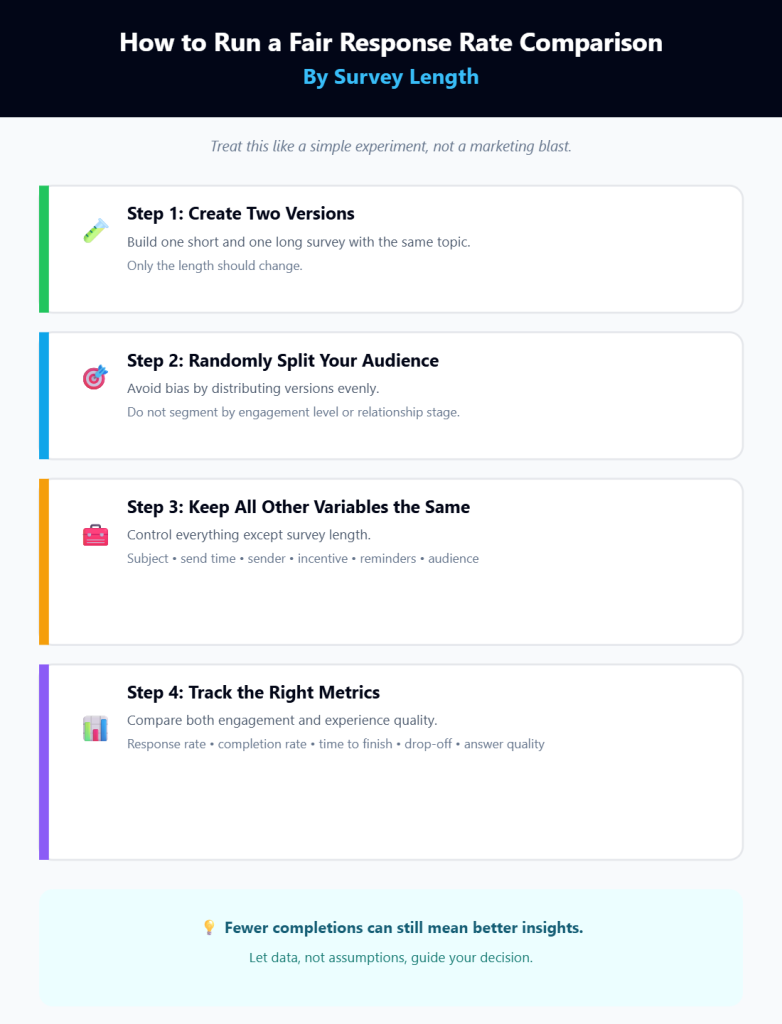
If you want to compare response rates by survey length in your own business, do it like a simple experiment.
Step 1: Create Two Versions
- Version A: Short survey
- Version B: Long survey
Keep the topic identical. Only change the length.
Step 2: Randomly Split Your Audience
Do not send the short version to your best customers and the long version to cold leads. That will skew the results.
Step 3: Keep Everything Else the Same
To make it a fair comparison:
- Same subject line
- Same send time
- Same sender name
- Same audience type
- Same incentive
- Same reminder schedule
Step 4: Track Both Response and Completion
Track:
- Response rate
- Completion rate
- Time to complete
- Drop-off points
- Quality of open-ended answers
This is where the real story shows up. The long survey might get fewer completions but better detail from the people who finish.
How to Increase Response Rates Without Cutting Length
Sometimes you truly need a longer survey. In that case, you can still protect your response rate by reducing friction.
1. Be Honest About Time
If a survey takes 12 minutes, say it takes 12 minutes. People hate surprises. Stating time clearly can improve trust even if fewer people start.
2. Use Progress Bars Carefully
A progress bar can help some respondents. But if it shows slow progress early, it can also scare people off. Test it.
3. Cut Any Question That Does Not Change a Decision
A great rule is:
If the answer will not change what you do, remove the question.
A lot of surveys get long because teams ask “nice to know” questions.
4. Use Skip Logic
Skip logic makes surveys feel shorter because people only answer what applies to them.
Examples:
- If they do not use Feature X, skip all Feature X questions.
- If they are not a customer, skip billing questions.
5. Put Easy Questions First
SurveyMonkey’s timing research shows people spend the most time on the first question and speed up later. Make the first few questions simple so people build momentum.
6. Save Open-Ended Questions for Key Moments
Open-ended questions are valuable, but they add effort.
Use them:
- once early, if you need context
- once late, as a final “anything else” catch-all
Do not sprinkle five open-ended questions throughout unless you are paying people or interviewing a very motivated audience.
7. Offer a Fair Incentive
Incentives can help offset length. The medical study mentioned earlier found completion increased when compensation was added. That does not mean you must pay everyone, but it does mean you should respect people’s time.
Common incentives:
- Gift cards
- Discount codes
- Donation to charity
- Early access to a feature
- Entry into a raffle
A Simple Cheat Sheet: Survey Length vs Expected Results
Here is a practical way to set expectations.
1–3 questions
- Best for: maximum completion
- What you get: quick, high-volume feedback
4–8 questions
- Best for: short product or customer surveys
- What you get: solid insight with decent completion
9–14 questions
- Best for: deeper but still manageable surveys
- What you get: more detail, lower completion
15+ questions
- Best for: research or highly motivated audiences
- What you get: deeper insight, much higher drop-off risk
Based on Survicate’s dataset, completion drops significantly as questions increase, and once you cross 15 questions you should plan for completion around the low 40% range.
Common Mistakes That Hurt Response Rates
Even short surveys can perform badly if you make these mistakes.
- No clear purpose: People do not know why they should answer.
- Too many matrix questions: They feel like homework.
- Repeating questions: Causes frustration.
- Asking for sensitive info early: People quit when they feel judged.
- No mobile-friendly layout: A big percentage of surveys are opened on phones.
- No follow-up: If you never share results or changes, people stop taking your surveys.
Wrap Up
Survey length has a real and measurable impact on response and completion rates. Short surveys win on participation, while longer surveys can deliver deeper insight but usually come with higher drop-off and more fatigue.
If the goal is quick feedback, keep surveys under 5 minutes and under 10 questions when possible. If you truly need a longer survey, make it feel worth it with skip logic, smart question order, and a fair incentive.
The easiest way to improve your survey results is not a fancy tool or a clever subject line. It is simply respecting the respondent’s time. When your survey feels easy and useful, people are much more likely to finish it.


Leave a Comment