Performance reviews occupy a peculiar place in organizational life. Most employees approach them with a mix of anticipation and dread. Most managers complete them with varying degrees of attention and care. And most HR leaders privately acknowledge that the process, in many organizations, generates documentation that accurately reflects the review cycle rather than the employee’s actual contribution.
The problem is rarely a lack of intention. Organizations that run ineffective performance reviews almost always want to run good ones. The failure typically lives in the gap between what a review is supposed to accomplish — a genuine, evidence-based assessment of contribution, growth trajectory, and future development — and what the process actually produces when time is short, templates are generic, and the system creates more friction than it removes.
HR platforms have substantially changed what’s possible here. When performance review infrastructure is properly configured and integrated with ongoing feedback data, goal tracking, and manager documentation throughout the year, the annual or semi-annual review becomes a synthesis of existing evidence rather than a rushed reconstruction. The difference in output quality between those two approaches is significant, and so is the difference in how the reviewed employee experiences the process.
What Makes a Performance Review Process Actually Work
Before examining how to configure and run reviews inside an HR system, it’s worth being clear about what a functional review process is actually trying to achieve — because misaligned objectives are where most review processes go wrong at the design stage.
A review serves three distinct purposes simultaneously. It assesses past performance, creating a documented record of contribution relative to expectations and goals set at the start of the period. It informs compensation and promotion decisions, providing a structured basis for differentiating among employees in a defensible way. And it identifies future development opportunities, giving the employee a clear picture of where growth investment would most benefit their career trajectory within the organization.
When a single review process is expected to serve all three purposes with equal effectiveness, it frequently underserves all three. Organizations that separate the developmental conversation from the compensation discussion — sometimes scheduling them in different months — consistently report that both conversations become more honest and more useful. The developmental discussion loses the defensiveness that compensation anxiety introduces. The compensation discussion becomes more direct when it isn’t tangled with development feedback the employee is simultaneously trying to process.
Whatever structure your organization chooses, clarity about what each component of the review is designed to accomplish is the prerequisite for configuring it correctly inside your HR system. Gallup’s State of the American Workplace research found that only 14% of employees strongly agree their performance reviews inspire them to improve — a figure that reflects how far most current review processes are from their stated developmental purpose.
Setting Up the Review Cycle in Your HR Platform
The mechanical configuration of a performance review cycle in an HR platform — launch dates, reviewer assignments, form templates, reminder sequences, calibration windows — determines whether the administrative process supports the quality of the conversation or undermines it.
Calibration before distribution. The most common configuration mistake in performance management setup is distributing review forms to managers before calibration has occurred at the leadership level. When managers complete ratings independently — without a shared reference for what “meets expectations” and “exceeds expectations” mean across the organization — the resulting ratings reflect each manager’s individual interpretation rather than an organizational standard. This creates inequity across teams, undermines trust in the process, and complicates compensation decisions. Configuring your HR system to hold ratings in draft state until post-calibration approval is one of the most impactful procedural changes most organizations can make.
Review form design matters more than most HR teams acknowledge. Generic rating scales applied uniformly across all roles and levels produce data that looks comprehensive but is difficult to act on. The most effective review forms are role-calibrated — they assess the competencies and behaviors that actually distinguish high performance in a given role rather than a one-size-fits-all behavioral inventory. Most modern HR platforms allow form templates to be created by job family or level and assigned automatically based on the employee’s role, which removes the manual work of routing the right form to the right reviewer.
Self-assessments add value when positioned correctly. Self-assessments are most useful as preparation tools — giving the employee’s manager visibility into how the employee perceives their own contribution before the manager’s assessment is finalized — rather than as scored inputs that are averaged into a final rating. Configuring self-assessments to open slightly before manager assessments, with manager visibility enabled, creates a structured opportunity for the manager to address significant divergences between self-perception and observed performance in the review conversation.
360-degree feedback requires careful scoping. Multi-rater feedback processes generate valuable peer and cross-functional input when the reviewer pool is chosen thoughtfully, but they create noise and sometimes political complexity when too broadly applied. Limiting 360 feedback to roles where cross-functional collaboration is a primary performance dimension, and keeping the reviewer count to three to five people who have genuine working visibility into the employee’s performance, produces more actionable input than wide-net feedback requests.
Running the Actual Review Conversation
The form completion is not the review. The conversation is the review. HR systems that treat form submission as the endpoint of the process have configured the review around the wrong objective.
Managers who conduct high-quality review conversations typically do several things that average-quality conversations skip. They reference specific examples — documented incidents, project outcomes, client feedback — rather than offering general impressions. They distinguish between what happened in the current period and what they expect in the next one. They make space for the employee to respond to the assessment before drawing conclusions. And they end with clear, specific commitments about next steps — whether that’s a development resource, a stretch assignment, a compensation adjustment, or a performance improvement conversation.
HR systems support this when they make continuous documentation easy throughout the year — check-in notes, project feedback, goal progress updates — so the manager entering the review period has a record to draw from rather than relying on memory of the last twelve months. According to SHRM research on performance management effectiveness, managers who document performance observations throughout the year conduct meaningfully better annual reviews and generate significantly less recency bias in their assessments than those who rely on end-of-period recall.
Three HR Platforms and How They Handle Performance Reviews
BambooHR — Structured Reviews for Growing SMBs

BambooHR builds performance management into its HR platform with a focus on accessibility for HR teams that don’t have dedicated performance specialists. Its review cycle configuration walks administrators through launch settings, form assignment, reviewer routing, and deadline management in a guided workflow that minimizes the configuration complexity that trips up smaller teams.
Its self-assessment and manager assessment forms run in parallel with a side-by-side view available to managers after submission, making it straightforward to identify significant gaps between employee self-perception and manager assessment before the conversation takes place. BambooHR also stores performance history across review cycles within each employee’s profile, giving managers and HR teams longitudinal visibility into how an employee’s ratings and feedback have evolved over time — context that’s frequently missing in systems where historical reviews are filed separately from current employee data.
Rippling — Performance Reviews Integrated With HR and Compensation Workflows
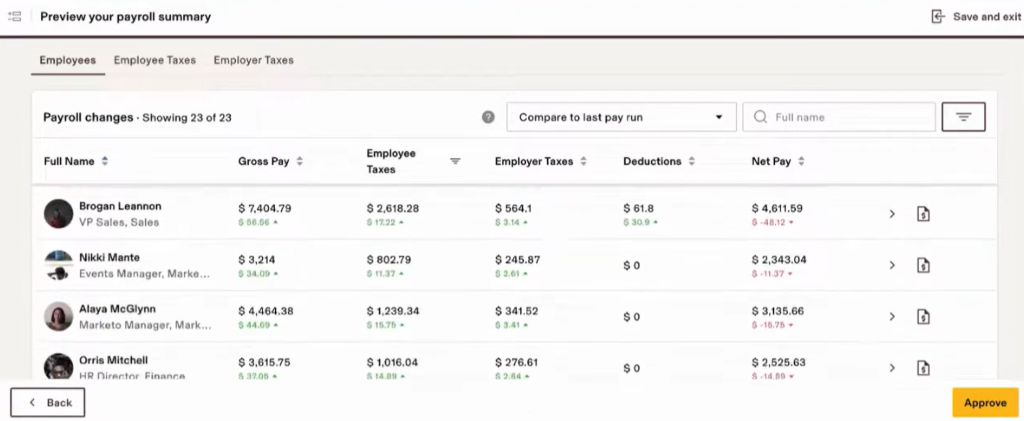
Rippling approaches performance management as one component of a unified people operations platform that connects HR, payroll, and IT. For organizations where performance outcomes feed directly into compensation cycles, that integration removes the manual reconciliation step between the performance system and the payroll system — the review conclusion triggers the compensation workflow within the same platform rather than requiring export, calculation, and re-import.
Its review configuration supports customizable rating scales and competency frameworks at the role or department level, addressing the generic-form problem that produces inconsistent data across teams. Rippling’s analytics layer surfaces performance distribution data across teams and managers, which supports calibration conversations with actual data rather than manager-by-manager impressions — particularly useful for larger organizations where review inflation or compression patterns need to be identified and corrected.
Factorial HR — Performance Management for International and Growing Teams
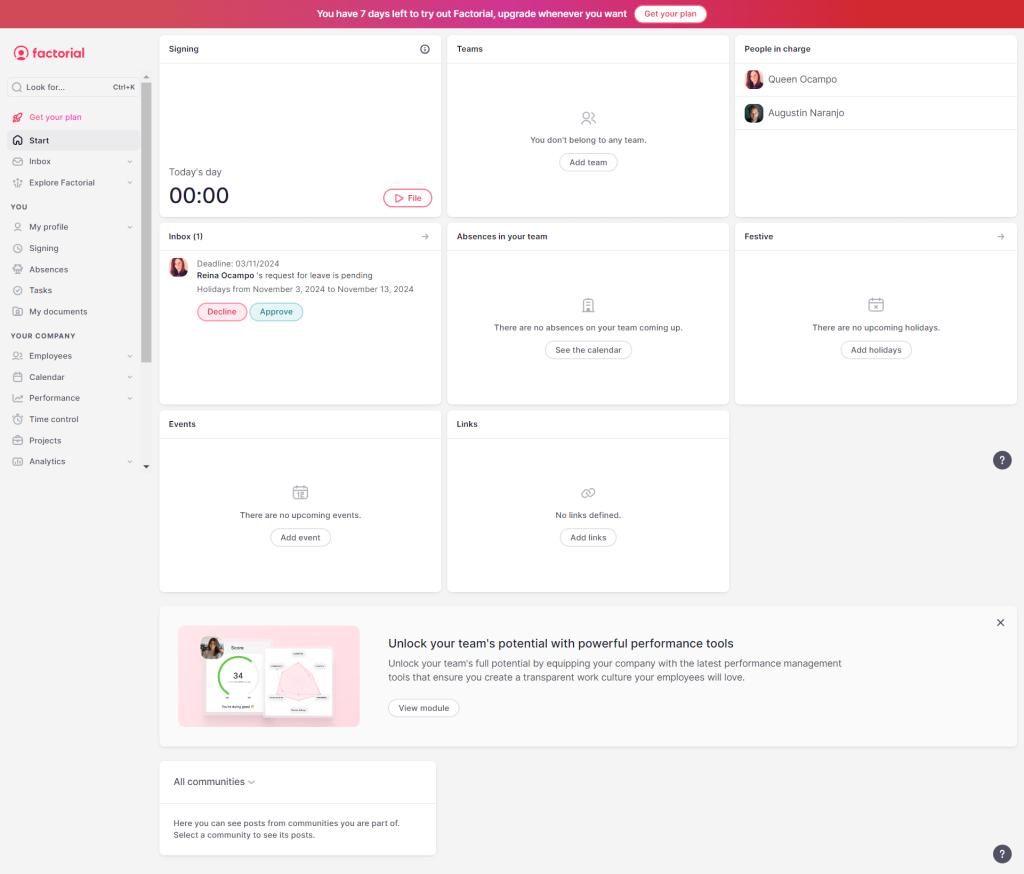
Factorial HR provides a performance review module designed for organizations managing employees across multiple locations and regulatory environments — contexts where a single review framework needs to accommodate different local expectations and legal requirements around performance documentation.
Its review cycle management includes customizable review templates, multi-rater feedback configuration, and automated reminder sequences that keep the review process moving through the completion window without requiring HR to manually chase outstanding submissions. Factorial’s goal-setting module integrates with its performance review cycle, so managers entering the review period have visibility into the employee’s goal progress data within the same system — connecting the goal-setting conversation that happened at the period’s start with the assessment conversation at its close.
Common Configuration Mistakes That Undermine Review Quality
Even on capable platforms, certain configuration choices reliably produce poor review outcomes.
Opening the review window too close to the deadline for completion creates time pressure that drives low-effort submissions. Managers who receive a review reminder with three days to complete twelve assessments produce rushed, thin feedback that employees justifiably experience as inadequate recognition of their work. Building a longer review window — typically two to three weeks for manager assessments following a one-week self-assessment period — and sending reminders at the midpoint rather than only at the deadline produces substantially better completion quality.
Using numeric rating scales without behavioral anchors produces inconsistent ratings across managers. A “4 out of 5” on a scale where the only guidance is “exceeds expectations” reflects each manager’s individual interpretation of what exceeding expectations looks like. Rating scales anchored with specific behavioral descriptions — what “meets expectations” looks like for a given competency, with concrete examples — produce more comparable data across the organization.
Treating review form submission as closure prevents the follow-through that gives reviews organizational value. Configuring your HR system to trigger a follow-up development plan template after each review is completed — requiring managers to document at least one concrete development commitment within thirty days — closes the loop between assessment and action in a way that most review processes leave open.
For a broader view of how performance review cadence connects to overall hiring and retention metrics, our guide on time to hire metrics and benchmarks covers how organizations that invest in structured people operations practices — including performance management — consistently outperform on talent retention and hiring efficiency.
Conclusion
Performance reviews that work are not primarily a technology problem, but they are substantially a design problem — and HR systems are where the design gets implemented. Getting the configuration right: calibrated launch sequencing, role-appropriate form templates, continuous documentation throughout the year, and follow-through workflows after completion — converts the review cycle from a compliance exercise into a genuine management tool. The platform enables the process. The process enables the conversation. And the conversation is where the actual value of a well-run performance review lives.

Leave a Comment