
I used to work on a small hiring team. We needed to hire a software engineer. I thought it would take maybe two weeks. It took three months. Three! And by the time we sent the offer, the candidate had already taken another job.
That hurt. A lot.
That’s when I started learning about time to hire. And once I understood it, I realized we had been doing everything wrong. So let me tell you what I learned — in plain language, no fancy words.
What Is “Time to Hire” Anyway?
Okay so first, there are two numbers people mix up all the time. They sound similar but they mean different things.
- Time to fill is how long it takes from the day you open a job until the day someone says yes to the offer. That includes everything — writing the job post, getting it approved, finding people, interviewing them, making an offer. The whole thing!
- Time to hire is shorter. It only counts the days from when a specific candidate first enters your process to when they accept the offer.
Here is why this matters! If you only track one number, you might fix the wrong part of the process. Maybe sourcing is fast but interviews are too slow. Or maybe interviews are fine but you take forever to send the offer. Tracking both tells you exactly where things get stuck.
When I finally figured this out on our team, we realized our sourcing was actually okay. The problem was our interviews. We had five rounds! Five! No wonder people dropped out.
What Are the Normal Numbers?
I looked up a lot of data on this. LinkedIn’s Global Talent Trends research says the average time to fill across all industries is about 40 to 49 days. But it depends a lot on what kind of job you are hiring for.
Here is what I found for different types of jobs!
- Software engineers: 55 to 75 days. Yes, really! Engineers are hard to find. Everyone wants them. And companies make them do four, five, six interview rounds. By round three the good ones are already gone.
- Finance and accounting: 35 to 50 days. Senior roles take longer because you have to check credentials and stuff. Junior roles go faster.
- Healthcare: 45 to 60 days. Doctors and nurses need special licenses. You literally cannot skip steps. Some specialist roles take over 90 days in places where there aren’t many doctors.
- Sales: 25 to 40 days. Sales is fast! The interviews are simpler and companies really feel the pain of an empty sales seat.
- Marketing: 30 to 45 days. I was surprised by this one. Marketing has gotten more specialized over the years. So it is taking longer now than it used to.
- Operations and supply chain: 30 to 50 days. Really depends on the level. Entry roles can close in under three weeks. Senior supply chain roles with niche software skills? Two months sometimes.
When I shared these numbers with my hiring manager, his eyes went wide. We had been thinking 60 days was normal. For a sales role, that is way too slow!
What Is Considered Fast?
I made a little guide in my head over the years. Here is how I think about it now!
- Under 20 days means you are moving really fast. That usually only works for simple, high-volume roles. Think call center, retail, entry-level stuff.
- 20 to 35 days is a great speed! This is where most well-run teams land. It takes real effort to get here but it is very doable.
- 35 to 50 days is average. Not bad, not great. Worth checking if there is anything slowing you down unnecessarily.
- 50 to 70 days is slow. Something is probably broken in your process. Or you are understaffed on the recruiting side.
- Over 70 days is a problem! You are going to lose candidates. Good candidates do not wait that long. They have options.
The first time I mapped this out, I almost fell out of my chair. Our team was averaging 68 days. Across all roles! That explained so much.
Why Do People Hire So Slowly?
I learned that most slow hiring is not because the market is hard. It is usually because of things inside the company. Things you can actually fix!
- Nobody agreed on what the job was before they started. This is the big one. I saw it happen over and over. The job opens, candidates come in, and then the hiring manager goes “hmm, actually I wanted someone more senior.” Now you have wasted three weeks. You have to start over. Candidates are gone.
- Too many interview rounds. I already mentioned our five-round nightmare. Research actually shows that after four or five rounds, you are not getting better information. You are just making people wait longer. And good candidates quit and go somewhere faster.
- Slow feedback from interviewers. We had one interviewer who took eight days to submit his feedback. Eight days! By the time we were ready to move to the next step, the candidate had already started somewhere else. We had a rule after that: feedback within 24 hours. Non-negotiable.
- Only waiting for people to apply. For junior roles, this is fine. For hard-to-fill senior roles, you need to go find people. If you just sit there waiting for applications, you will be waiting a long time.
How Do You Actually Track This?
You need a system. A spreadsheet can work at first, but it gets messy fast. Once you start tracking things like “time in each stage,” you need something better.
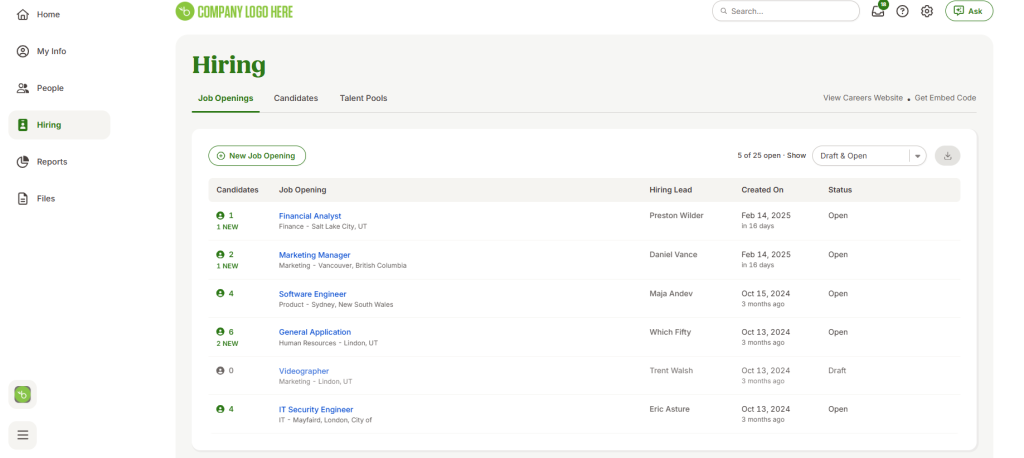
I started using BambooHR at my next company. It tracks how long each candidate spends in each stage of your hiring process. So instead of just knowing your total time to hire, you can see exactly where people are getting stuck. Is it the phone screen stage? The technical interview? The offer stage? You find out fast.
Big enterprise teams tend to use Workday. It has really detailed recruiting analytics. You can slice the data by department, by recruiter, by location, by job family. It is a lot of data but it is powerful. Especially if you are hiring in multiple countries or teams.
What surprised me was Rippling. I thought it was just an HR tool. But it connects recruiting, payroll, IT setup — everything. So when someone accepts an offer, their laptop gets ordered, their email gets set up, their payroll gets activated. All at once! The time from “accepted offer” to “actually working on day one” gets so much shorter. That matters too!
And of course LinkedIn Recruiter shows you how fast your sourcing is working. You can see how quickly candidates respond to your messages. You can see if your response rate is going up or down. That is a leading indicator for time to hire. Slow responses early means slow pipeline later.
According to SHRM’s Talent Acquisition Benchmarking Report, companies that use data to guide their sourcing consistently hire faster than companies that just post jobs and hope.
The Simple Tricks That Actually Helped Us
After all my mistakes, here is what actually moved the needle for our team!
We started every new role with a kick-off meeting. Just 30 minutes. Me, the recruiter, and the hiring manager. We agreed on what we needed. We agreed on the must-haves versus nice-to-haves. We agreed on salary before talking to anyone. That one change cut our average time to hire by almost two weeks. Just from fewer mid-process recalibrations!
We also moved to structured interviews. Every candidate got the same questions. Interviewers scored answers on the same scale. After interviews, decisions got made faster because everyone had comparable notes. No more “I liked her but I’m not sure.” Everyone had actual data.
And we set a 24-hour rule for interview feedback. Every interviewer had to submit notes within 24 hours. If someone was going to miss it, they had to tell the recruiter in advance. That rule felt annoying at first. But it made such a difference in momentum.
You Do Not Have to Choose Between Fast and Good
People say “you can hire fast or you can hire well, not both.” I used to believe that. I don’t anymore.
The things that make you hire faster are the same things that make you hire better! Clear criteria upfront. Structured interviews. Quick decisions. Those are not shortcuts. They are good practices. Slow processes are usually slow because of friction and disorganization. Not because of thorough evaluation.
I made better hires after we sped things up. Because we were clearer about what we wanted before we started looking.
Quick Summary Table
| Metric | What It Measures | Average Range |
|---|---|---|
| Time to Fill | Req open to offer accepted | 40–49 days (global median) |
| Time to Hire | Candidate entry to offer accepted | Shorter than time to fill |
| Tech / Engineering | Time to fill benchmark | 55–75 days |
| Sales | Time to fill benchmark | 25–40 days |
| Healthcare | Time to fill benchmark | 45–60 days |
| Finance | Time to fill benchmark | 35–50 days |
| Marketing | Time to fill benchmark | 30–45 days |
| Under 20 days | Speed rating | Aggressive / high-volume roles |
| 20–35 days | Speed rating | Efficient / well-run process |
| 35–50 days | Speed rating | Average — room to improve |
| Over 70 days | Speed rating | Problem — high dropout risk |
Conclusion
Hiring slowly costs you more than you think. The candidates you lose while waiting. The team running short-staffed. The revenue not made. It all adds up.
Track your numbers. Know your benchmarks. Fix the bottlenecks. And stop doing five interview rounds!



Leave a Comment