
The argument against time tracking tends to sound reasonable on first hearing: freelancers are paid for outcomes, not hours. A client wants a functional website, a polished report, a successful campaign — not a timesheet. Sophisticated professionals, the argument goes, should be above the clock-watching that characterizes hourly employment. Track your deliverables, protect your boundaries, and let the output speak for itself.
This view is coherent and wrong in ways that become progressively more expensive over time.
The case for time tracking in independent practice is not primarily about billing. It is about operating a business with accurate information rather than comfortable assumptions. The freelancer who doesn’t track time is not liberated from the constraints of hours — they are simply uninformed about how many hours their work actually requires. That ignorance has financial consequences: in scope creep they absorb silently, in rates set without reference to actual project economics, and in the recurring inability to understand which client relationships and project types generate genuine profit versus which ones consume disproportionate time relative to the revenue they return.
The question is not whether time tracking is necessary. For most freelance practices, it is. The question is what level of rigor the practice requires, and what tools serve that need without generating friction that makes the habit unsustainable.
The Real Cost of Operating Without Time Data
Independent professionals who have never tracked time seriously tend to share certain predictable blind spots.
Scope creep is the most visible. A project estimated at fifteen hours expands through additional revision cycles, extended feedback loops, and out-of-scope requests that accumulate incrementally — each one small enough to absorb without complaint, collectively large enough to halve the effective hourly rate on the engagement. Without time data, scope creep is a feeling rather than a fact. With time data, it becomes a quantified argument for a contract amendment or an adjustment to the next engagement’s scope definition.
Rate calibration is less visible but more consequential over time. Freelancers who set rates based on market comparisons or intuition — without reference to their own project economics — are essentially pricing by analogy. Two independent professionals charging identical hourly rates for the same type of work may have wildly different profitability if their actual hours per project diverge significantly. The one who tracks knows this. The one who doesn’t suspects it at best.
Tax documentation is the third area where the absence of time records creates problems that only become apparent under pressure. In many jurisdictions, the deductibility of home office space, professional software, and business-related expenses is linked to demonstrable business use. Time records that show when and how work was conducted provide supporting documentation that flat assertions of business use do not. Hiscox’s annual DNA of an Entrepreneur report consistently identifies poor financial record-keeping — including the absence of time and income tracking — as among the top operational risk factors for self-employed professionals and small business owners.
According to research from the freelance economy platform Malt, the most financially successful independent professionals consistently cite systematic business practices — including time and income tracking — as distinguishing habits that separate sustainable freelance careers from precarious ones.
When Simple Is Enough — And When It Isn’t
Not every freelance practice has the same time tracking requirements, and calibrating the tool to the actual need is as important as adopting the habit at all.
A photographer who charges per image delivered has limited use for per-minute granularity. A consultant billing by the day has different requirements than a developer billing by the hour. A writer operating on fixed-fee project pricing needs time tracking for internal calibration — understanding their economics — more than for client invoicing. A legal or financial professional in a regulated context may need auditable time records as a professional obligation rather than a business preference.
The minimum viable time tracking practice for most freelancers is simpler than the category’s reputation suggests: a record of what project time was spent on, in what volume, and on which dates, maintained with enough consistency to support monthly invoicing and quarterly tax review. That does not require sophisticated software. It requires a sustainable habit applied to any tool that makes the habit frictionless enough to maintain under deadline pressure.
Where sophistication pays off is in the analysis. The value of six months of clean time data is not the data itself — it is what the data reveals about where a freelance practice is actually earning versus where it is consuming time without proportionate return. That analysis requires sufficient granularity to compare performance across clients, project types, and rate structures.
Three Tools That Serve Different Freelance Approaches
ClickTime

ClickTime is positioned for professional services environments where time data needs to support both billing accuracy and operational analysis. Its reporting layer is more developed than most tools aimed at the freelance market — it allows time to be analyzed by client, project phase, task type, and team member simultaneously, producing the kind of project economics data that reveals where engagements are profitable and where they are not.
For an independent professional managing multiple concurrent client relationships — particularly in consulting, legal, accounting, or specialist agency work — ClickTime’s budget tracking feature provides real-time visibility into how logged hours relate to the project budget as the work progresses. That live comparison between budgeted and actual hours is what enables proactive scope conversations rather than retrospective explanations after a project has run over.
Teamwork
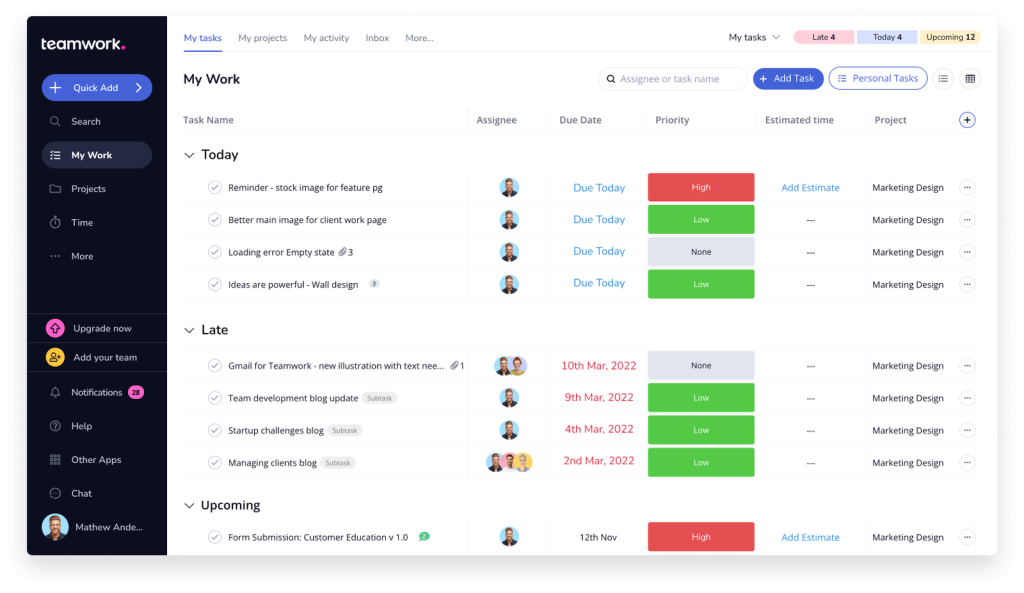
Teamwork addresses a specific friction point that affects freelancers managing structured client projects: the separation between project management and time tracking that most tools maintain. When time entries live in a separate application from the tasks they relate to, the discipline of connecting time to specific deliverables degrades — entries accumulate as generic project time rather than task-level records.
Teamwork’s time logging is embedded directly within the task structure, so logging time on a specific deliverable happens in the same interface where the work is managed. That integration produces naturally granular time records without requiring the discipline of separate systems. For freelancers who already use project management software to manage client work, the time tracking capability is additive rather than requiring a behavioral change to a separate tool and workflow.
Its billing report functionality converts logged hours into invoice-ready summaries by client and project, reducing the end-of-project administrative work of translating a timesheet into a bill.
Invoicely
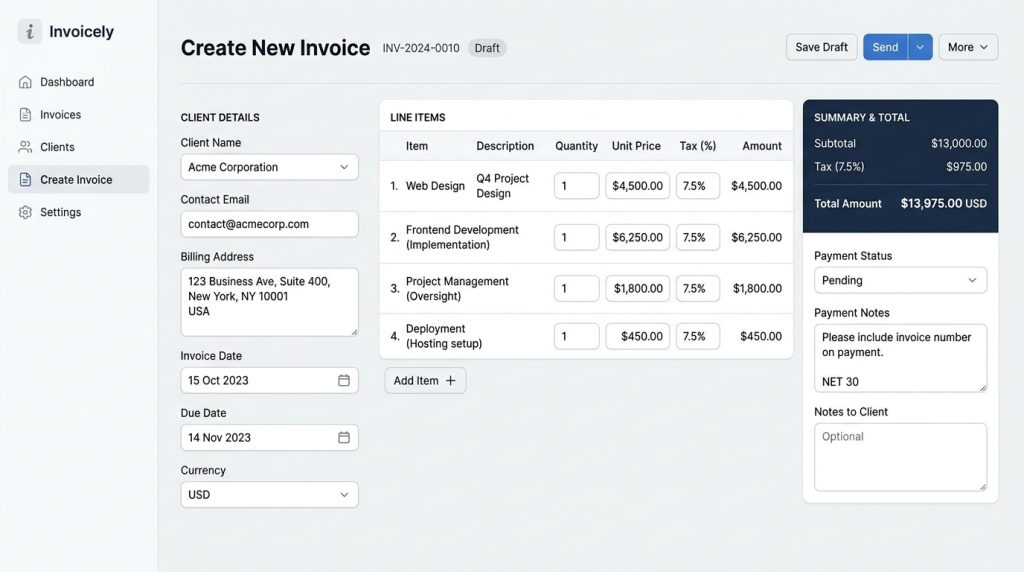
Invoicely approaches time and billing from the invoice end rather than the time entry end — a distinction that matters for freelancers whose primary workflow question is “what do I bill this client” rather than “how do I record every hour of my day.”
Its time tracking functionality is built to feed directly into invoice generation. Logged time against a client or project populates invoice line items automatically, with the option to apply different rates to different task types within the same engagement. For freelancers billing multiple clients at different rates for different categories of work — a writer who charges separately for research, drafting, and revision, for example — that rate differentiation at the task level produces more accurate invoices than a single blended rate applied to total hours.
Invoicely also handles recurring billing and retainer invoice scheduling, which makes it practical for independent professionals whose client relationships include regular monthly engagements alongside project-based work.
Building a Habit That Survives Busy Periods
The time tracking tool that works is the one you actually use when the deadline pressure is highest. That is the selection criterion that most evaluations underweight.
Adoption consistently fails not during quiet periods when the habit is easy to maintain, but during intensive delivery phases when switching between tools feels like friction that can’t be afforded. A tool that requires multiple clicks to log time, doesn’t have a mobile app for capturing time away from a desk, or lacks a quick-start timer accessible from a browser extension will see adoption collapse precisely when consistent tracking matters most.
The practical adoption framework that works for most independent professionals is: set up the tool during a low-pressure week, log time actively for thirty consecutive working days to establish the habit, and resist the temptation to evaluate the data until at least sixty days of records exist. The first thirty days produce the habit. The next thirty produce data worth analyzing.
The analysis phase — comparing actual project hours against original estimates, examining effective hourly rates across client relationships, identifying the work categories that consume disproportionate time relative to their billing weight — is where time tracking converts from an administrative task into a genuine business intelligence tool.
Our guide on how to track income and expenses as a freelancer covers the financial management practices that complement time tracking — together, the two disciplines provide the operational visibility that separates a well-run independent practice from one that perpetually feels busier than it is profitable.
The Verdict on Essential Versus Overkill
The framing of the debate — essential or overkill — contains an implicit false premise: that time tracking is a single thing with a fixed level of complexity. It isn’t.
For a freelancer billing fixed fees with stable project scope and a strong intuitive sense of their economics, the minimum viable version — a basic record of time by client and project maintained for invoicing and tax purposes — is sufficient and requires very little effort. That is not overkill. It is appropriate calibration.
For an independent professional managing multiple client relationships, variable project types, and rates that need periodic review against actual performance data, a more structured approach with task-level granularity and regular analysis of project economics is not optional infrastructure. It is the mechanism by which the business remains informed about itself.
The question is not whether to track time. It is how much structure the practice needs, and whether the tool chosen makes that structure sustainable rather than aspirational.



Leave a Comment