
Grab your coffee, pull up a chair, and let’s have a very real talk. You finally took the leap into freelancing, right? You set up your desk, you landed a couple of decent clients, and you are officially your own boss. It is a fantastic feeling! But then, somewhere around month three, reality hits you like a cold splash of water.
A client asks for an invoice you thought you already sent. You look at your bank account and realize you have no idea which deposits are from your side hustle and which are birthday money from your aunt. And the receipts? They are fading into oblivion at the bottom of your tote bag. We have all been there. The freelance life is heavily romanticized on social media with pictures of people working from beachside cafes, but nobody posts selfies of themselves crying over a chaotic spreadsheet at midnight right before taxes are due.
Managing your money doesn’t have to be a nightmare, though. It honestly just takes a few good habits, the right systems, and a little bit of discipline. Today, we are going to figure out exactly how to track your income and expenses so you can stop stressing about money and get back to actually doing the work you love.
The Chaos We All Start With (And Why It Has To Stop)
Let’s be completely honest with each other for a second. When you first start working for yourself, your financial tracking system is usually just… hoping for the best. You might have a random note on your phone with a list of people who owe you money. You might have a physical folder where you shove receipts for printer ink and client lunches.
Here is the problem with the “hope for the best” method: you are actively losing money. When you don’t track your income meticulously, invoices fall through the cracks. Clients are busy, and if you aren’t on top of your receivables, a 500 USD project can sit unpaid for months simply because you forgot to follow up.
On the flip side, not tracking your expenses means you are going to overpay on your taxes. Every time you buy a piece of software, pay for web hosting, or grab a coffee while working from a cafe, that is a potential deduction. If you lose the receipt or forget to record it, you are essentially handing the government free money. We work way too hard to let our hard-earned dollars slip away just because we were too disorganized to write them down.
Step One: The Sacred Separation of Church and State
Before we talk about apps, spreadsheets, or tax deductions, we have to fix the biggest mistake almost every new freelancer makes. You absolutely must separate your personal money from your business money.
Right now, you probably have one checking account. Your rent comes out of it, your grocery bill comes out of it, and your client payments go into it. It is a giant, tangled mess. You might tell yourself, “Oh, I will definitely remember that this 45 USD charge was for my website domain and not for that fancy takeout I ordered on Friday.” Spoiler alert: you will not remember. Six months from now, it will all look like a blur.
Go to your bank, or find a solid online bank, and open a dedicated business checking account. It is usually free and takes about ten minutes. From this day forward, every single penny you make from freelancing goes into that account. Every single business expense you pay for comes out of that account.
According to the IRS guidelines for small businesses, you can only deduct expenses that are both ordinary and necessary for your business. If the IRS ever decides to look closely at your finances, handing them bank statements where business software purchases are mixed in with your late-night Amazon shopping sprees is a massive red flag. Keep it clean. Keep it separate. It is the absolute foundation of taking yourself seriously as a business owner.
Ditching the Spreadsheet for Actual Tools
Okay, so you have your separate bank account. Now, how are we actually recording the money moving in and out?
A lot of people start with a spreadsheet. Spreadsheets are fine for your first month. But by month twelve? A spreadsheet is a fragile, terrifying thing that breaks if you type a formula wrong. You end up spending more time managing the spreadsheet than you do managing your actual business.
It is time to graduate to actual accounting software. This doesn’t mean you need a finance degree. Modern tools are built for creative people who hate math. For example, if you want a robust, industry-standard tool that your accountant will absolutely love you for using, you might want to look into setting up QuickBooks Online. It connects directly to your new business bank account, pulls in all your transactions automatically, and basically does the heavy lifting for you. You just log in, tell it what the transaction was for, and you are done.

If you are a designer, writer, or consultant and you really care about how your invoices look, you might lean toward something a bit more visually appealing. Sending a beautiful, professional invoice makes you look incredibly polished. Many freelancers swear by FreshBooks because it handles the expense tracking perfectly but really shines when it comes to time tracking and sending invoices that clients can pay with a credit card right from their email.

The tool you pick matters less than the fact that you actually use it. You want something that syncs with your bank so you aren’t doing manual data entry. Manual data entry is the enemy of productivity!
The Art of Categorization
Once your bank is connected to your software, you are going to see a list of transactions. Now comes the part where you actually have to tell the software what these things are. This is called categorization, and it is the secret sauce to keeping more of your money.
When money comes in, it is pretty simple: it’s income. But when money goes out, you need to put it into the right bucket. Did you buy a new laptop? That is office equipment. Did you pay for an Adobe subscription? That is software and tools. Did you pay for a flight to a conference? That is business travel.
Why do we care about these buckets? Because at the end of the year, your tax professional (or your tax software) needs to know exactly how much you spent in each category to figure out your deductions. If you just throw everything into a category called “Miscellaneous,” your accountant is going to yell at you.
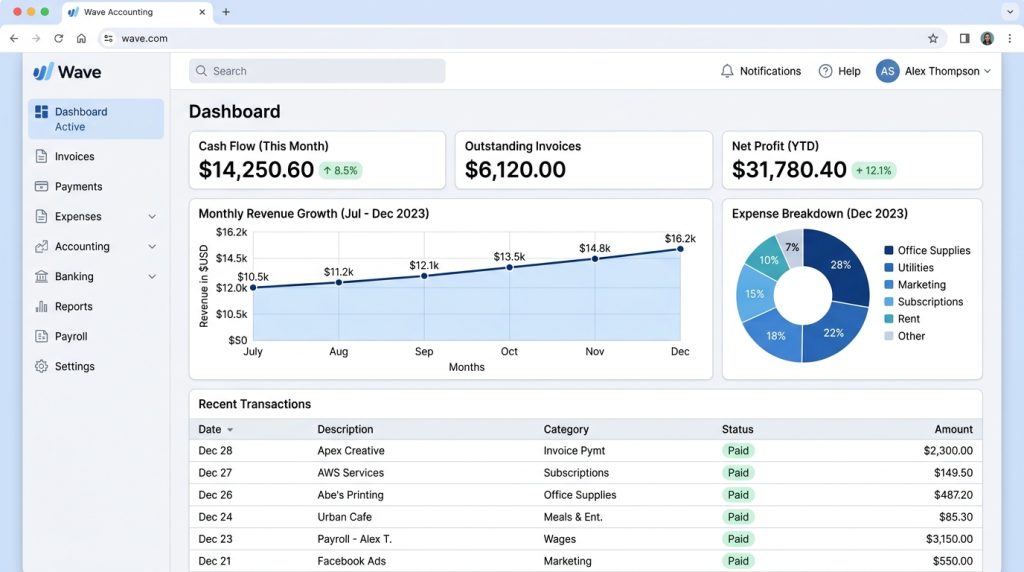
If you are super new to this and the idea of paying a monthly fee for software stresses you out, don’t worry. There are fantastic free tools out there that handle this categorization beautifully. I always tell beginners to check out Wave because it offers totally free accounting and invoicing, which is a lifesaver when you are bootstrapping your freelance business with zero budget. It lets you create those specific categories so you are perfectly organized without spending a dime on the software itself.
Chasing the Money (Because You Deserve to Get Paid)
Let’s talk about the fun part: the income. Tracking your expenses is defensive, but tracking your income is offensive.
When you send an invoice, your job is not done. You have to track whether or not that invoice actually gets paid. The freelance world is notorious for late payments. In fact, studies from the Freelancers Union have shown that a shocking percentage of independent workers struggle with clients who pay late, or sometimes don’t pay at all, resulting in thousands of dollars in lost income every year.
This is why your tracking system needs to be ruthless. You need a dashboard that shows you exactly who owes you money and how many days past due they are. Don’t rely on your memory! Set your software to send automatic payment reminders. Let the robots be the bad guys. If an invoice is three days late, the software automatically sends a polite, automated email saying, “Hey, just a friendly reminder that this invoice is due.” It removes the emotional friction of having to personally hound your clients for cash.
Always ask for a deposit upfront, too. Tracking a 50 percent upfront payment in your system before you even start working gives you peace of mind and keeps the cash flowing while you do the actual work.
Taming the Paper Trail
We need to talk about receipts. The IRS requires you to keep documentation for your business expenses. But physical receipts are terrible. They get lost in your pockets, they go through the laundry, and the ink on those thermal paper receipts literally fades into a blank white strip of nothingness after a few months.
You need to digitize everything immediately. The second you buy something for your business—whether it is a stack of notebooks or a business dinner—you take a picture of the receipt. Do not put it in your pocket. Do not put it in your car’s cupholder.

There are dedicated tools that make this incredibly easy so you never lose a deduction. You can use an app like Expensify on your phone. You just snap a picture of the receipt while you are still standing at the cash register, the app reads the merchant name and the amount, and it stores it safely in the cloud. Then you can confidently throw the crumpled piece of paper directly into the recycling bin. Your digital records are now bulletproof.
Building Your Finance Friday Routine
Systems are great, but they only work if you actually look at them. You cannot set up all this beautiful software and then ignore it until April 14th. If you do that, you will be right back in panic mode.
You need a routine. I like to call it “Finance Friday.” Pick one day a week—it literally only takes about 20 to 30 minutes—to sit down with your coffee, put on some good music, and look at your money.
During this weekly check-in, you are going to do three things. First, you look at your bank feed and categorize the 5 or 10 transactions that happened that week. It is so much easier to remember what a 12 USD charge was when it happened three days ago compared to three months ago.
Second, you look at your outstanding invoices. Who hasn’t paid? Do you need to pause work for a client who is two weeks late?
Third, you move money into savings for taxes. As a freelancer, taxes are not withheld from your checks like they are at a normal job. You owe self-employment tax, plus income tax. A good rule of thumb is to take 25 to 30 percent of every single payment you receive and immediately transfer it to a separate, untouchable savings account. When tax season rolls around, you just pull the money from that account. No stress, no surprise credit card debt to pay the government.
Wrapping It Up
Listen, I know talking about tracking income and expenses isn’t as exciting as talking about branding, landing dream clients, or designing a cool portfolio. But financial hygiene is the ultimate form of self-care for freelancers.
When you know exactly how much money is coming in, you can confidently turn down bad clients. When you know exactly how much money is going out, you can figure out where to cut back so you can actually pay yourself more.
Setting up the bank accounts, picking the software, and building the weekly routine takes a little bit of effort upfront. But once the system is humming along, it runs in the background of your life. You get to stop worrying about the math and get back to doing the creative, amazing work you started this freelance journey for in the first place. You’ve got this!

Leave a Comment