Most prospects do not ignore you because they hate your product. They ignore you because the timing is wrong, the message is too generic, or you asked for a sale before you earned trust. That’s exactly what nurture sequences are for.
A nurture sequence is a planned set of emails (and sometimes texts, ads, or LinkedIn touches) that helps a prospect move from “just browsing” to “ready to talk.” It’s not about spamming people with follow-ups. It’s about staying helpful, consistent, and relevant until they are ready.
In this guide, you’ll learn how to build nurture sequences that feel human, get replies, and create sales opportunities without sounding pushy.
What a Nurture Sequence Really Is?
A nurture sequence is not one email. It’s a conversation over time.
Instead of sending one pitch and hoping someone buys, you send a series of messages that:
- Educate the prospect
- Build credibility
- Handle objections
- Show proof
- Make the next step easy
The best nurture sequences have a clear goal. That goal is usually one of these:
- Book a call
- Get a demo request
- Get a reply
- Move them to a trial
- Get them to consume key content
If you do not define your goal, the sequence turns into random emails and your results will suffer.
Start With Segmentation (Or Your Sequence Will Fail)
Before writing anything, decide who this sequence is for. The biggest mistake is sending the same sequence to everyone.
Segment prospects by:
- Where they came from (downloaded a guide, webinar signup, referral, cold outreach)
- Their intent level (high intent: pricing page visits. low intent: blog reader)
- Industry or role (marketing manager vs founder vs IT lead)
- Problem they care about (speed, cost, compliance, growth, retention)
- Lifecycle stage (new lead, engaged lead, sales-ready lead, stalled lead)
Even simple segmentation improves results because the emails feel personal instead of mass-produced.
Map the Prospect Journey First
A nurture sequence should match how people actually buy. Most buying journeys fit into three stages:
Awareness Stage
The prospect is trying to understand the problem. They are not ready for a demo.
What they need:
- Clarity
- Education
- A way to name the problem
Consideration Stage
Now they are comparing options and approaches.
What they need:
- Frameworks
- Comparisons
- Real examples
- Proof that your approach works
Decision Stage
They are close to taking action. Now they want confidence.
What they need:
- Case studies
- Pricing guidance
- Onboarding details
- Risk reduction (guarantees, support, timelines)
When you match your emails to these stages, your nurture feels natural. When you don’t, your emails feel pushy or irrelevant.
Choose the Right Type of Nurture Sequence
Not every nurture sequence is the same. Pick the one that fits the situation.
1. New Lead Welcome Sequence
Best for: newsletter signups, lead magnets, new trial signups.
Purpose:
- Set expectations
- Deliver value fast
- Teach them what to do next
2. Educational Nurture Sequence
Best for: prospects who are early stage.
Purpose:
- Build trust
- Position your brand as the guide
- Warm them up for a future CTA
3. Product or Demo Nurture Sequence
Best for: prospects showing high intent.
Purpose:
- Answer objections
- Show outcomes
- Push toward a call or demo
4. Stalled Deal Sequence
Best for: prospects who went quiet after a call or proposal.
Purpose:
- Restart the conversation
- Rebuild urgency
- Reduce risk and uncertainty
5. Re-Engagement Sequence
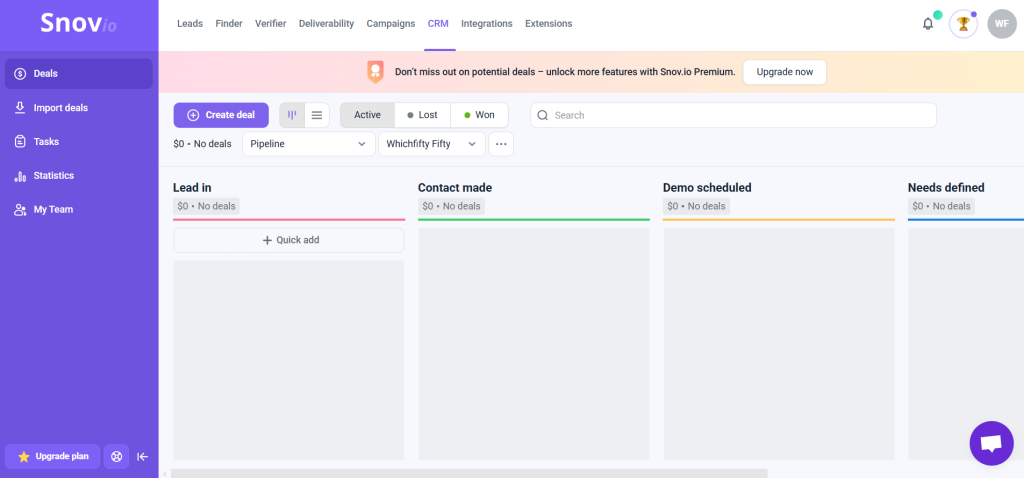
Best for: inactive leads who have not opened or clicked in a while. To simplify the process, it’s ideal to use an apps like Snov, which will simplifies this step.
Purpose:
- Spark interest again
- Clean the list if needed
- Give an easy yes/no choice
Once you pick the sequence type, writing becomes much easier.
The Simple Structure That Works (And Feels Human)
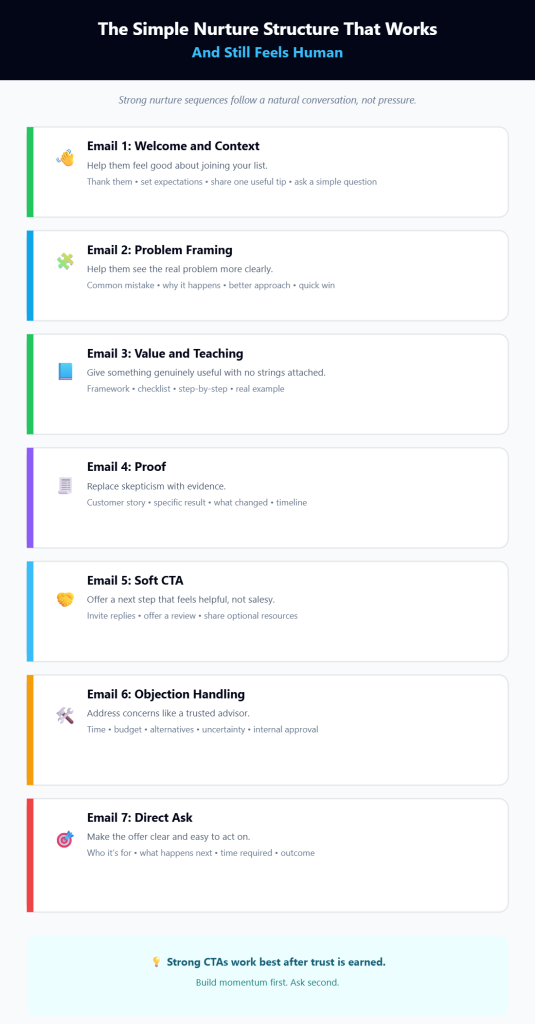
Most good nurture sequences follow a clear flow. Here’s a structure you can use for almost any industry.
Email 1: The “Welcome and Context” Email
Goal: Make them feel like they made the right choice by joining your list.
Include:
- A quick thank you
- What they can expect
- One valuable tip or resource
- A simple question
Keep it short. This email sets the tone.
Email 2: The “Problem Framing” Email
Goal: Help them understand the problem more clearly.
Include:
- A common mistake people make
- Why it happens
- A better approach
- One quick win they can try today
This is where trust starts building.
Email 3: The “Value and Teaching” Email
Goal: Give them something genuinely useful.
Include:
- A framework
- A checklist
- A step-by-step process
- An example from your experience
If your content is actually helpful, prospects start looking forward to your emails.
Email 4: The “Proof” Email
Goal: Reduce skepticism.
Include:
- A short customer story
- Specific results
- What changed
- How long it took
People trust proof more than promises.
Email 5: The “Soft CTA” Email
Goal: Offer a next step that does not feel aggressive.
Examples:
- “Want me to review your current setup?”
- “Reply with your biggest challenge and I’ll point you to the best resource.”
- “If you want, here’s a short demo video.”
Soft CTAs get more replies than hard sells.
Email 6: The “Objection Handling” Email
Goal: Address what’s stopping them.
Common objections:
- Not enough time
- Not enough budget
- Already using another tool
- Not sure if it will work for their situation
- Need internal approval
Handle objections like a helpful advisor, not like a closer.
Email 7: The “Direct Ask” Email
Goal: Book the call, demo, or trial upgrade.
Be clear:
- Who it’s for
- What happens next
- How long it takes
- What they get
A direct ask works best after you have built momentum.
Timing and Cadence: How Often Should You Send?
Cadence depends on whether this is warm nurturing or cold outreach.
For cold outreach sequences, many teams keep it tight and limited. A common best practice is an initial email plus follow-ups spread across several days, then pausing for a longer period before trying again. One guide suggests a 3-email sequence with follow-ups after a few days, then waiting a couple months before re-engaging if there’s no response.
For opt-in nurture sequences, weekly or biweekly consistency tends to work better, especially when you are sending useful content and not just pitching.
A practical approach that stays safe for most businesses:
- Days 1 to 7: 2 to 3 emails (to build momentum)
- Weeks 2 to 4: 1 email per week
- After that: move them into a regular newsletter or topic-based nurture
The biggest rule: do not bombard people. Consistency beats intensity.
What to Write in Each Email (With Real Examples)
Here are examples of email angles that work across most industries. You can adapt these into your own voice.
Helpful Teaching
- “Here’s a simple way to fix X in 15 minutes.”
- “Most teams do Y first, but Z should come earlier.”
Pattern Recognition
- “If you’re seeing these 3 symptoms, it’s usually caused by…”
- “Here’s how to tell if you’re ready for the next step.”
Case Study Angle
- “How one team cut their turnaround time from 7 days to 2.”
- “The 3 changes that made the biggest difference.”
Quick Story
- “A prospect told me something last week that surprised me…”
- “This mistake cost a team months. Here’s what they changed.”
Simple Ask
- “What are you using today to manage this?”
- “Reply with your goal and I’ll send the best next resource.”
These kinds of emails feel like a real person wrote them.
Make Your Nurture Sequence More Personal (Without Creeping People Out)
Personalization is not only using someone’s first name.
Better personalization includes:
- Mentioning their industry or role
- Referencing the lead source (“you downloaded the guide on…” )
- Sending content based on what they clicked
- Adjusting CTAs based on intent signals
Keep it respectful. Avoid saying things that make them feel watched, like “I saw you visited our pricing page three times.”
Instead, try:
- “If you’re evaluating options right now, here’s a simple checklist…”
That feels helpful, not creepy.
Add Triggers So the Sequence Gets Smarter
The best nurture sequences are not one fixed path. They adapt.
Useful triggers:
- If someone clicks the pricing link, move them into a high-intent sequence.
- If someone replies, stop the automation and hand off to sales.
- If someone does not open the last 3 emails, slow down or switch to re-engagement.
- If someone books a call, stop the nurture and start onboarding content.
This keeps your messaging aligned with the prospect’s reality.
Don’t Forget These Key Parts
A nurture sequence usually fails for simple reasons. Here’s what to check.
Subject Lines
Keep them natural, simple, and curiosity-driven.
Examples:
- “Quick question”
- “Worth considering?”
- “A simple way to fix this”
- “Is this a priority right now?”
Avoid spammy words and too many exclamation marks.
One Clear CTA Per Email
Do not ask them to:
- watch a demo
- read a blog
- book a call
- follow you on social
all in the same email.
Pick one action.
Mobile-Friendly Formatting
Most people read email on their phone.
Use:
- short paragraphs
- space between sections
- bullets
- simple language
Consistency
One of the biggest best practices is sending nurture emails on a consistent schedule. When prospects know what to expect, trust builds.
How to Measure If Your Nurture Sequence Works
Do not judge success by opens only. Open tracking is not always accurate.
Track:
- Replies (best signal for B2B)
- Clicks to key pages (pricing, demo, case study)
- Demo bookings
- Trial starts
- Trial-to-paid conversions
- Unsubscribes and spam complaints
Also track drop-off points:
- Which email causes people to stop engaging?
- Which email gets the most replies?
Then improve one email at a time.
Simple Templates You Can Copy
Below are quick templates you can adapt.
Template: Education Email
Subject: A simple way to improve X
Hi [Name],
A quick idea that helps with [problem].
Most teams try [common approach]. The issue is it usually leads to [pain].
Instead, try this:
- Step 1
- Step 2
- Step 3
If you want, reply with what you are doing today and I’ll suggest the next best step.
Template: Proof Email
Subject: What changed for [Company Type]
Hi [Name],
A [industry] team was dealing with [problem].
They changed three things:
- Change
- Change
- Change
Result: [specific outcome].
If you want to see if this fits your situation, the next step is a short call. Want me to send times?
Wrap Up
Creating nurture sequences for prospects is really about one thing: building trust in small steps.
When you segment your audience, match the buyer journey, and send useful emails on a steady schedule, prospects stop seeing you as “another company selling stuff.” They start seeing you as the helpful guide who understands what they need.
Start simple. Write a 7-email sequence using the structure above. Give value first, add proof, handle objections, then make a clear offer. Track replies and conversions, then improve one email at a time.
Over time, your nurture sequences will do what every marketing team wants: create warm, ready-to-buy prospects without constant chasing.
Leave a Comment