What happen if your product becomes famous over the night in TikTok, just imagine. Orders flood your inbox, and you run out of stock by midday. You rush to order more, but your supplier takes a month to ship. By the time the boxes land at your door, the trend is dead. Now you’re staring at stacks of unsellable products, and your cash is completely locked up.
Inventory is a tough balancing act. Buy too much, and you’ll burn cash on warehouse rent. Buy too little, and you’re handing sales to your competitors.
To keep your head above water, you need a system. That’s where inventory forecasting and demand planning come in. These tools aren’t just for corporate supply chain experts; they are simple, common-sense methods to verify what inventory you actually need. Let’s look at how to get started.
How Do Forecasting and Demand Planning Differ?
While they sound identical, they focus on two different timelines:
- Inventory forecasting looks backward. You take your past sales receipts and use them to estimate next month’s volume. It’s essentially using last year as your roadmap.
- Demand planning is forward-looking and strategic. It takes that historical forecast and layers in external factors: your upcoming marketing campaigns, market trends, launch dates, and economic conditions.
For example, forecasting tells you that you usually sell one hundred jackets in October. Demand planning tells you that because you’re running a massive social media promotion this October, you should actually order one hundred and fifty.
Using inventory management tools like Kaldana helps you keep tabs on these levels in real-time, making it easier to transition from simple guessing to actual planning. According to Investopedia, getting a handle on demand planning is the most effective way to cut operating costs and run a leaner supply chain.
Why You Can’t Afford to Skip Forecasting
If you’re still ordering stock based on “gut feeling,” you’re actively losing money. Here is why structured forecasting changes the game:
- Clear out slow stock early: If you spot a quiet month on the horizon, mark down your slower-moving items ahead of time. This frees up shelf space before the inventory turns into dead stock.
- No more stockout panic: When you run out of a popular item, customers don’t wait for you to restock. They go to your competitors. Having a buffer based on actual sales data keeps your shelves full.
- Cut down warehouse costs: Every square foot of storage space costs money. If you keep items moving instead of sitting on shelves, your warehousing fees drop significantly.
- Keep cash liquid: Remember, stock is just frozen money. If fifty thousand dollars is sitting in boxes in the back room, you can’t use it to pay bills, run advertisements, or hire help.
The Key Ingredients of a Good Forecast
To build a realistic forecast, you have to look at a few main data points:
- Historical sales: Look at what you sold over the last twelve to twenty-four months. This is your foundation.
- Seasonal spikes: Almost every business experiences natural high and low periods. Swimsuits sell in summer, coats sell in winter. You need to map these cycles.
- Market conditions: Is there a new competitor in town? Are material costs rising? Is consumer spending slowing down? For example, if a direct competitor is closing down, you might get a massive flood of their old customers. If they are launching a huge discount campaign on a product similar to yours, you might need to scale back your orders.
- Coordinate with your marketing: If you’re planning a massive influencer campaign next month, relying on last year’s standard numbers will leave you empty-handed. You’ll need to manually increase your orders to handle the promo traffic.
Using tracking software like Sortly makes it easy to organize this historical data and tag seasonal items, so you aren’t digging through messy spreadsheets when it’s time to reorder.
What Is Demand Planning?
Here’s a simple setup you can use:
Step 1: Clean up your records
A forecast is only as reliable as the numbers behind it. You need to record actual sales, product returns, and damaged items. If your logs are messy, your predictions will be off.
Step 2: Use dedicated software
Get rid of the paper checklists and manual ledgers. Use unique programs for the maths. if you’re overseeing orders and promos across multiple teams, sync your inventory targets to Zoho Projects to keep designers, marketers and suppliers all on the same page.
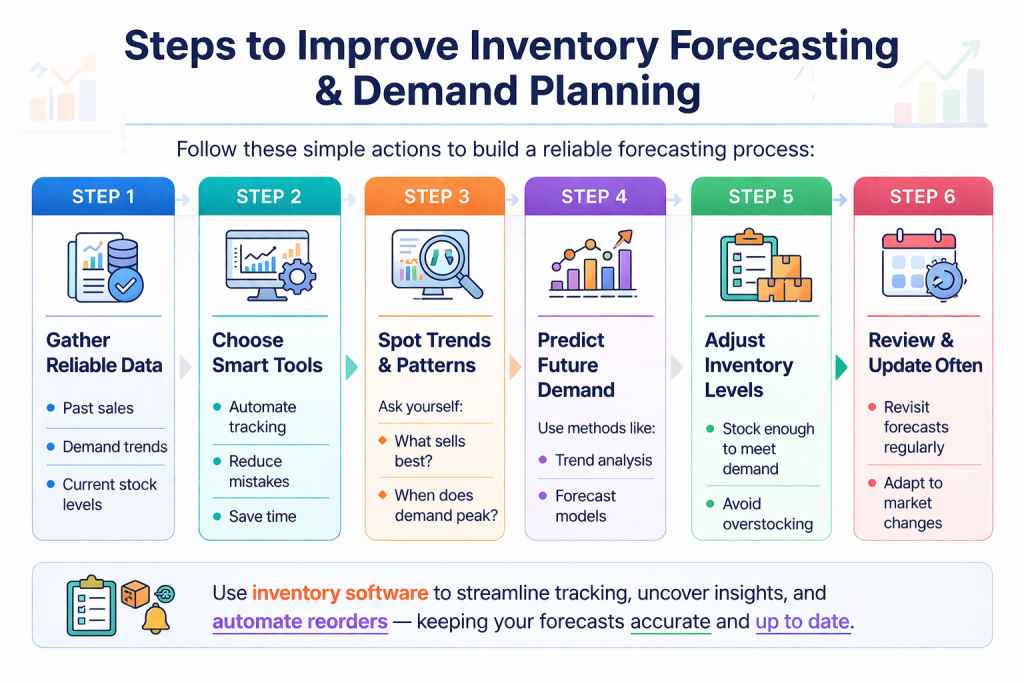
Step 3: Identify your trends
Look back at your sales numbers from the past twelve months. Pinpoint your absolute bestsellers, find the items that just sit on the shelves, and note the exact weeks when sales naturally jump.
Step 4: Map out your numbers
Use last year’s patterns and your upcoming marketing schedule to write down sales projections for the next three months.
Step 5: Keep a safety buffer
Don’t order the exact amount you expect to sell. Always buy a small buffer of safety stock. If your supplier is overseas, a customs hold, a port strike, or bad weather can easily double your delivery window. A small extra reserve is your insurance policy.
Step 6: Watch and adjust
Don’t write a forecast and file it away. Check your actual numbers against your estimates every single month. If you predicted fifty sales but hit eighty, increase your upcoming orders immediately.
Manual tracking can lead to errors. Using inventory management tools makes the process more efficient and accurate. These tools help you monitor stock levels, analyze trends, and automate reordering.
Inventory Mistakes That Will Cost You
Even with the best tools, mistakes can happen. Here are some common ones to watch out for.
- Assuming history always repeats: Just because an item sold well last summer doesn’t mean it will do the same this year. Trends shift, and customer interests fade.
- Forgetting your supplier’s schedule: If your manufacturer takes six weeks to make and deliver a batch, you can’t wait until your warehouse is empty to place the next order. Factor in the transit time so you don’t run dry.
- Forgetting about promotions: If your marketing team launches a 20 percent off coupon without telling the warehouse team, you’ll run out of stock in a day. Communication is key.
Avoiding these mistakes helps businesses maintain better control over inventory.
Final Thoughts
Setting up a forecasting process keeps your cash flowing, storage costs down, and customers happy. Start by sorting out your past sales data, pick a tool like Kaldana or Sortly to track changes, and check your numbers weekly. Your bottom line will show the difference.



Leave a Comment