
If your store gets traffic but sales feel stuck, you are not alone. Most e-commerce sites do not have a traffic problem. They have a conversion problem.
Your conversion rate is simply the percentage of visitors who buy. Small improvements here can change everything. A bump from 2% to 3% might not sound huge, but it can mean 50% more orders from the same traffic. That is why smart brands obsess over conversion rate improvement, not just ad spend.
In this blog, we will cover e-commerce conversion rate benchmarks, what a “good” conversion rate looks like, and practical ways to improve it with simple changes. At the end, you will find the reference sources listed together, as requested.
What Is an E-Commerce Conversion Rate?
Your e-commerce conversion rate tells you how many visitors take the action you want, usually buying a product.
The most common formula is:
Conversion Rate = (Number of Orders ÷ Number of Visitors) × 100
So if 10,000 people visit your store and 250 purchase, your conversion rate is 2.5%.
A few important notes:
- Conversion rate can be measured for your whole store, a product page, a landing page, or even checkout.
- The “right” conversion rate depends on your industry, traffic quality, device type, and price point.
- It is not just about buying. You can also track micro conversions like email signups or add-to-cart actions.
E-Commerce Conversion Rate Benchmarks (2025)
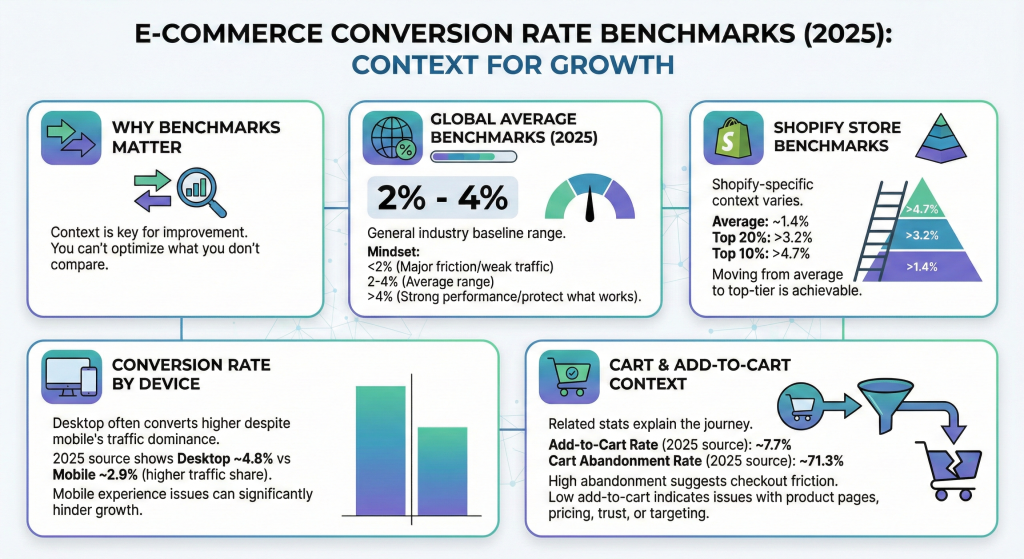
Benchmarks matter because they give you context. You cannot fix what you cannot compare.
Global Average Benchmarks
Many industry sources place the global average e-commerce conversion rate in 2025 between 2% and 4%. This range is often used as a general baseline for most stores.
A solid internal mindset is:
- Below 2%: You likely have major friction or weak traffic.
- 2% to 4%: You are around the average range.
- Above 4%: You are doing very well and should protect what is working.
Shopify Store Benchmarks
If you run on Shopify, benchmarks look a bit different.
Shopify industry commentary and benchmark surveys often mention:
- Average Shopify conversion rate around 1.4%.
- Stores above 3.2% are often considered in the top 20% of Shopify stores.
- Stores at 4.7% or higher are commonly referenced as top 10% performers.
These numbers are useful because they show that “average” is not always the same across platforms. It also proves something important: moving from average to top tier is possible if you make the right improvements.
Conversion Rate by Device
In many benchmark reports, desktop converts higher than mobile, even though mobile traffic is usually larger. For example, one 2025 benchmark source notes desktop conversion around 4.8% vs mobile around 2.9% and also mentions mobile taking a large share of traffic.
This is a big deal because it means:
- Your mobile experience can quietly kill conversions.
- Fixing mobile issues can deliver fast growth without spending more on ads.
Cart Abandonment and Add-to-Cart Benchmarks
Conversion rate does not exist alone. Two related stats help explain what is happening:
- Add-to-cart rate around 7.7% in a 2025 benchmark.
- Cart abandonment rate around 71.3% in the same benchmark.
If your add-to-cart rate is decent but abandonment is high, the problem is probably checkout friction. If add-to-cart is low, your product pages, pricing, trust, or targeting might be the issue.
What Impacts Conversion Rate the Most?
Conversion rate is not magic. It is the result of many small decisions.
Here are the biggest levers that usually matter:
- Traffic quality: Are you attracting the right people or just anyone?
- Offer clarity: Do people understand what they get and why it is worth it?
- Trust: Reviews, returns, shipping transparency, security signals.
- Speed: Slow pages lose sales fast, especially on mobile.
- Checkout friction: Too many fields, forced account creation, surprise fees.
- Product fit: The best CRO cannot save a weak product-market fit.
One of the best ways to improve conversion is to stop guessing and find the exact point where people drop off.
How to Diagnose Your Conversion Rate (Before You Fix It)
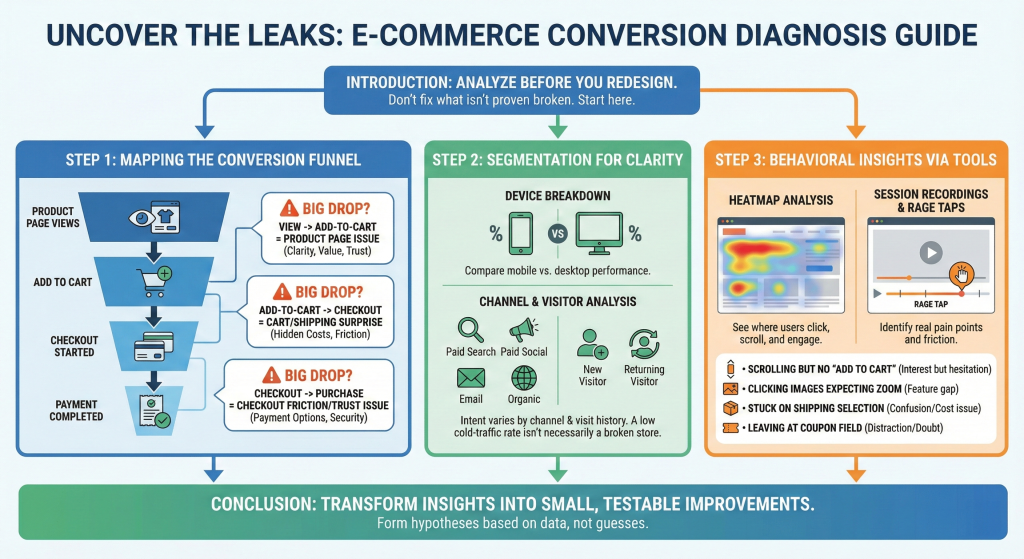
Before you redesign your store, you need to know what is actually broken.
Step 1: Check Your Funnel Numbers
Look at these key stages:
- Product page views
- Add to cart
- Checkout started
- Payment completed
If you see a big drop between:
- Product view and add-to-cart: product page problem.
- Add-to-cart and checkout: cart problem or shipping surprise.
- Checkout and purchase: checkout friction or payment trust issue.
Step 2: Segment by Device and Channel
Always look at conversion rate by:
- Mobile vs desktop
- Paid search vs paid social vs email vs organic
- New vs returning visitors
A store might convert 4% on email traffic and 1% on cold paid social. That does not mean your store is broken. It means your traffic intent is different.
Step 3: Use Session Recordings and Heatmaps
Tools that show where users click, scroll, and rage-tap help you see the real pain points.
Common things you will notice:
- People scrolling but not clicking “Add to cart”
- Clicking product images expecting zoom
- Getting stuck on shipping selection
- Leaving at coupon code fields
Use these insights to form small, testable changes.
Conversion Rate Improvement Strategies That Work
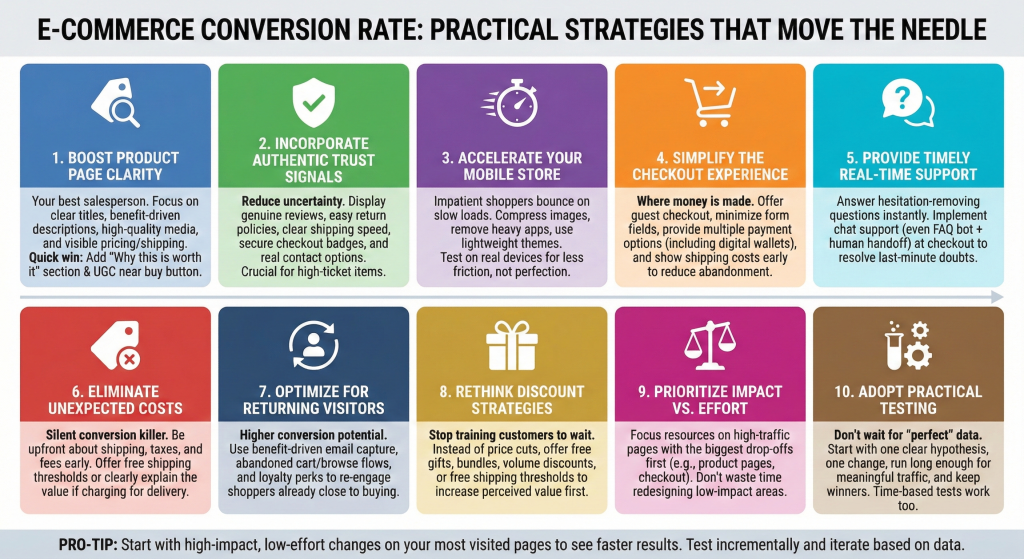
Now for the part you actually want. Here are practical improvements that usually move the needle, especially when done in the right order.
1. Improve Product Page Clarity
Your product page is your best salesperson. Make it do its job.
Focus on:
- Clear product title and simple benefit-driven description
- High quality images and video
- Visible pricing, shipping info, and returns
- Strong call to action button that stands out
Quick wins:
- Add a short “Why this is worth it” section above the fold.
- Use real customer photos or UGC if possible.
- Put your reviews closer to the buy button.
2. Add Trust Signals Without Looking Spammy
People do not buy when they feel unsure.
Trust builders include:
- Reviews and ratings
- Easy returns
- Shipping speed clarity
- Secure checkout messaging
- Real brand story and contact options
If you sell higher-ticket products, trust becomes even more important because the risk feels higher.
3. Speed Up Your Store (Especially on Mobile)
Mobile shoppers are impatient. If pages load slowly, conversion drops.
Basic improvements:
- Compress images
- Remove heavy apps you do not need
- Use lightweight themes
- Test on real phones, not just desktop previews
Your goal is not perfection. Your goal is less friction.
4. Make Checkout Simple and Calm
Checkout is where money is made or lost.
Strong checkout improvements often include:
- Guest checkout option
- Fewer form fields
- Multiple payment options, including digital wallets
- Clear error messages
- Shipping cost clarity early
Many CRO guides recommend simplifying checkout and reducing fields because complicated checkouts increase abandonment.
5. Offer Real-Time Support at the Right Moment
Some buyers just need one question answered.
Adding chat support can help, especially at checkout, because it removes hesitation.
This does not mean you need a 24/7 team. Even a simple FAQ chatbot plus fast human handoff during business hours can work.
6. Reduce Surprise Costs (The Silent Conversion Killer)
One of the most common reasons people abandon checkout is unexpected shipping, taxes, or fees.
Fixes:
- Show estimated shipping early
- Offer free shipping thresholds
- Be upfront about taxes
- Avoid hidden handling fees
If free shipping is not possible, be honest and explain what the customer gets in return (fast delivery, insured shipping, premium packaging).
7. Optimize for Returning Visitors
Returning visitors convert higher than new ones in many stores.
Simple strategies:
- Email capture with a clear benefit, not “Join our newsletter”
- Abandoned cart emails
- Browse abandonment flows
- Loyalty points or member perks
Even one good abandoned cart flow can lift overall conversion rate fast because those shoppers were already close to buying.
8. Stop Overusing Discounts
Discounts can increase conversion, but they also train customers to wait.
Better options:
- Free gift with purchase
- Bundle offers
- Volume discounts
- Free shipping threshold
- Limited-time bonus instead of price cut
A good CRO mindset is: increase perceived value first. Discount last.
9. Use Impact vs Effort Prioritization
One strong best practice is to focus on high-traffic pages with the biggest drop-offs first. That usually means product pages and checkout.
Do not waste weeks redesigning a low-traffic page when your checkout is leaking sales.
10. Test Like a Normal Person, Not a Lab Scientist
A/B testing is great, but many small brands get stuck waiting for “perfect” data.
Start with:
- One clear hypothesis (example: “Shipping info above the fold will reduce checkout drop-off.”)
- One change
- Run the test long enough to collect meaningful traffic
- Keep what wins
Even without formal A/B testing, you can run time-based tests if you have stable traffic.
Benchmarks You Should Track Alongside Conversion Rate
If you only track conversion rate, you miss the “why.”
Track these too:
- Add-to-cart rate
- Checkout initiation rate
- Cart abandonment rate
- Average order value (AOV)
- Revenue per visitor (RPV)
- Returning customer rate
- Refund and chargeback rate
Sometimes conversion rate improves but AOV drops due to discounts. That can be a bad trade. Watch the full picture.
What a “Good” Goal Looks Like
A realistic approach is:
- Step 1: Get to the average range for your niche
- Step 2: Stabilize performance and improve quality traffic
- Step 3: Push toward top tier benchmarks
If you are at 1.2% today, aiming for 2% is a strong goal. If you are at 2.8%, aiming for 3.5% is a good next step.
For Shopify stores, benchmarks often point to 3.2% as top 20% and 4.7% as top 10%, which gives you long-term targets to work toward.
Wrap Up
Conversion rate improvement is not about random hacks or copying what other stores do. It is about removing friction and building trust, step by step.
Start by understanding your funnel. Then fix the biggest leaks first, usually mobile experience, product page clarity, and checkout simplicity. Track the supporting metrics like add-to-cart rate and cart abandonment so you know what is actually improving.
Most importantly, keep it simple. One strong improvement each month compounds fast. By the end of the year, your store can look completely different without a massive rebuild.



Leave a Comment