Cart abandonment happens to almost every online store. Someone adds items, gets excited, then disappears right before paying. It feels frustrating, but it is also normal. Industry data often puts average cart abandonment around 70%. That means the real question is not “How do we stop it completely?” It is “How do we recover more of it?”
That is where cart abandonment reminders come in. Whether you use email, SMS, push notifications, or retargeting ads, reminders bring shoppers back when they are still interested. But to improve results, you need to track the right conversion metrics. Otherwise, you will keep sending reminders without knowing what is actually working.
This guide breaks down the most important cart abandonment reminder conversion metrics, what “good” looks like, and how to use the numbers to get more orders.
What Counts as a Cart Abandonment Reminder?
A cart abandonment reminder is any message sent after a shopper leaves checkout without buying. It usually includes the products left behind and a clear way to return to the cart.
Common reminder channels include:
- Email reminders (the classic choice for most stores)
- SMS reminders (great for urgency and quick action)
- Push notifications (useful if you have an app or web push)
- Retargeting ads (keeps products visible on social and search)
Some brands use only email. Others run multi-step flows across several channels. Either approach can work, but metrics tell you where your biggest wins are.
The Two Big Numbers: Abandonment Rate and Recovery Rate
Before you get into email open rates and click rates, get clear on these two.
Cart Abandonment Rate
This is the percent of shoppers who add items to cart but do not finish purchase. It is often calculated as:
(Carts created minus purchases) ÷ carts created
The widely quoted average sits around 70%. Your number may be higher or lower depending on pricing, shipping, device mix, and how smooth your checkout is.
Abandoned Cart Recovery Rate
This is the percent of abandoned carts you bring back and convert into orders. A common benchmark range is 3% to 5% recovery for many stores. Strong performers often recover 10% to 14%.
A simple formula looks like:
(Recovered carts ÷ abandoned carts) × 100
If you only track one thing, track recovery rate. It is the clearest signal that your reminders are making you money.
Email Metrics That Matter Most
Email is still the main channel for cart recovery because it is cheap, easy to automate, and can include product images, pricing, reviews, and incentives.
Here are the key conversion metrics to track.
Open Rate
Open rate tells you how many people opened the email. Abandoned cart emails often have higher open rates than normal campaigns. Some benchmarks suggest 45% to 50% open rates can be common for cart reminders.
What affects open rate:
- Subject line clarity
- Brand trust
- Timing (how soon you send it)
- Inbox placement and deliverability
Click-Through Rate (CTR)
CTR shows how many people clicked a link inside the email.
Some sources cite around 21% CTR for abandoned cart emails, while other studies show different ranges depending on industry and tracking method. The key is to compare your own CTR over time, not chase one magic number.
What improves CTR:
- A strong “Return to cart” button
- Clear product visuals
- Short, friendly copy
- Mobile-friendly layout
Conversion Rate
This is the percent of people who received the cart email and went on to buy.
Conversion rates vary a lot. Some studies cite double-digit conversion for cart emails depending on how conversion is defined. What matters most is consistency in your definition and tracking.
A practical way to measure:
- Purchases from cart email clicks ÷ total cart emails delivered
Revenue Per Recipient (RPR)
This metric answers: “How much money does each email recipient generate?”
Some datasets report abandoned cart flows can produce strong RPR compared to other automated flows. RPR is powerful because it keeps your team focused on revenue, not vanity engagement.
Unsubscribe Rate and Complaint Rate
Your reminder flow should not annoy people. Some benchmark data suggests ecommerce unsubscribe rates can be very low, around fractions of a percent. Even if your conversion is good, watch for spikes. If unsubscribe rates jump, your timing or frequency may be too aggressive.
SMS and Multi-Channel Metrics
Email is not the only recovery channel. SMS and multi-channel flows can lift conversions, especially for repeat customers.
SMS Click Rate and Conversion Rate
SMS is short and direct, so engagement can be strong. SMS recovery campaigns have been shown to drive meaningful recovered revenue in certain case studies. The core metrics to track:
- Delivery rate
- Click rate
- Conversion rate
- Revenue per message
- Opt-out rate
Cross-Channel Assisted Conversions
A shopper might click the email, then later return via a retargeting ad and buy. If you only look at last-click attribution, you may undervalue one channel.
Track:
- Assisted conversions
- Time to purchase after first reminder
- Total recovered revenue by flow (not just by message)
Timing Metrics: When You Send Matters
Cart reminder timing is one of the biggest levers you control.
Many best-practice guides recommend sending the first reminder quickly, often within the first hour or within a few hours. Some sources suggest a 2 to 3 email sequence with carefully spaced intervals.
A simple timing framework:
- First reminder: 30 minutes to 2 hours after abandonment (friendly nudge)
- Second reminder: 12 to 24 hours later (add reassurance, reviews, FAQs)
- Final reminder: 24 to 48 hours later (add urgency, limited incentive if needed)
Key timing metrics to watch:
- Time to first reminder
- Time from reminder to purchase
- Purchases by send window (morning vs evening)
- Purchases by device type
Checkout Friction Metrics That Predict Abandonment
Cart abandonment reminders help, but they work even better when checkout friction is reduced. Track these to understand why shoppers leave.
Checkout Completion Rate
This is the percent of shoppers who start checkout and finish. If this is low, reminders will help, but fixing checkout will help more.
Payment Failure Rate
Track how often payments fail due to:
- Payment method limitations
- Card declines
- Buggy payment flow
Shipping Surprise Rate
You cannot directly track “shipping shock,” but you can spot it with:
- Drop-offs on shipping step
- Drop-offs after shipping cost is revealed
- High abandonment on mobile where shipping details are harder to see
What “Good” Looks Like: Practical Benchmarks
Benchmarks vary by industry, brand strength, and price point. Still, it helps to have ranges.
Here are realistic targets to work toward:
- Cart abandonment rate: Often around 70% on average
- Recovery rate: Typical 3% to 5%, strong 10% to 14%
- Cart email open rate: Often can be much higher than standard email, sometimes in the 40%+ range
- Cart email CTR: Can reach double digits depending on setup and segment
Use benchmarks as a starting point, then focus on improving your own baseline week by week.
How to Build a Cart Reminder Metrics Dashboard
A dashboard keeps you honest. It shows what is improving and what is stuck.
Here is a clean dashboard structure.
1) Flow-Level Metrics (Big Picture)
Track:
- Abandoned carts (count)
- Recovered carts (count)
- Recovery rate
- Recovered revenue
- Revenue per abandoned cart
2) Message-Level Metrics (Email or SMS)
Track for each message in the sequence:
- Delivery rate
- Open rate (email)
- CTR
- Conversion rate
- Revenue
- Unsubscribe or opt-out rate
3) Segment-Level Metrics (Who Converts)
Break out results by:
- New vs returning customers
- High AOV vs low AOV
- Mobile vs desktop
- Product category
- Geography
Often you will find that returning customers convert at higher rates. That is normal. It also tells you where to aim incentives.
How to Improve Conversion Metrics (Without Guessing)
Once you have tracking in place, improvements become much easier.
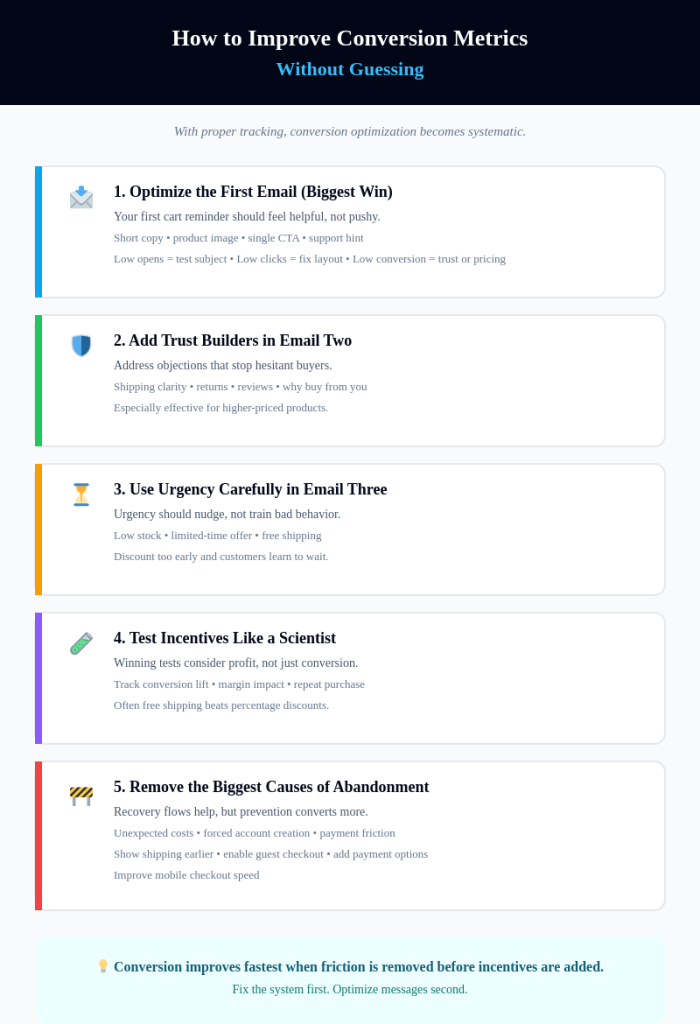
Improve the First Email (Most Stores Win Here)
Your first cart reminder should feel like a helpful tap on the shoulder.
Best practices:
- Keep the copy short
- Show the product image and name
- Use one strong CTA button
- Add a quick support line like “Need help checking out?”
If open rates are low, test subject lines. If CTR is low, improve layout and CTA. If conversion is low, the issue might be pricing, shipping, or trust.
Add Trust Builders in Email 2
Your second message can answer common objections:
- Shipping speed and cost
- Returns policy
- Product reviews
- “Why buy from us?” points
This often improves conversion for higher-priced items.
Use Urgency Carefully in Email 3
This is where many brands add:
- Low stock notices
- Limited-time discounts
- Free shipping offers
Be careful with discounts. If you discount too fast, customers learn to abandon carts on purpose.
Test Incentives Like a Scientist
When you test offers, track:
- Conversion lift
- Profit impact (not just revenue)
- Repeat purchase rate afterward
Sometimes “free shipping” beats “10% off” because it feels simpler.
Fix the Top Reasons People Abandon
Reminder flows recover carts, but removing friction prevents abandonment in the first place. Based on common ecommerce research, big drivers include unexpected costs, account creation friction, and payment issues.
Simple fixes:
- Show shipping costs earlier
- Offer guest checkout
- Add more payment options
- Improve mobile checkout speed
Common Tracking Mistakes to Avoid
A few mistakes can make your data useless.
- Counting opens as success: Opens do not pay the bills. Track revenue and recovery rate.
- Not filtering bots and privacy opens: Email privacy features can inflate opens.
- Only using last-click attribution: You may undervalue channels that assist.
- No control group: If possible, hold out a small group from reminders to see true lift.
- Ignoring deliverability: A great email does nothing if it lands in spam.
Wrap Up
Cart abandonment reminders are one of the easiest ways to get more revenue without more traffic. But the real win comes when you track the right conversion metrics and keep improving the flow.
Start with the basics: abandonment rate, recovery rate, open rate, CTR, conversion rate, and revenue per recipient. Then go deeper with timing, segmentation, and friction metrics so you can spot exactly where shoppers drop off and what brings them back.
If you build a simple dashboard and run small tests every month, you will keep lifting conversions over time. Even a small improvement in recovery rate can turn into a big jump in monthly revenue.

Leave a Comment