Think of choosing an e-commerce platform like choosing a commercial kitchen to run your restaurant from. Some kitchens come fully equipped, staff included, but the rent is steep and you’re working to their rules. Others hand you an empty room and a gas line — total freedom, but you’re sourcing every pot, pan, and plate yourself. Neither is wrong. But walking into the wrong one is an expensive mistake that takes months to undo.
That’s the real conversation nobody has when someone googles “best e-commerce platform.” They expect a ranked list. What they actually need is a quick self-assessment: What are you selling? How much technical work are you willing to do? Do you want to own your audience or rent access to someone else’s? The answers narrow the field fast.
Here’s an honest breakdown of what the major options actually do well — and who they’re genuinely built for.
First, the Question That Changes Everything
Before platform features matter at all, there’s one question that should drive your entire decision: do you want to build a store or join a marketplace?
They sound like the same thing. They are fundamentally different businesses.
Building a store means you own the experience. Your domain, your customer email list, your branding, your data. You decide the look, the pricing, the promotions, the checkout flow. When a customer buys from you, they know exactly who they bought from. The downside: you bring your own traffic. Nobody discovers your store by accident. You earn every visitor through SEO, ads, social, or word of mouth.
Joining a marketplace means you access built-in traffic from day one. Platforms like Etsy or Amazon already have millions of daily shoppers. You set up a listing, and those shoppers can find you without you having to generate a single backlink. The tradeoff: you don’t own the relationship. The marketplace sets the rules, controls what customers see next, takes a meaningful commission, and could adjust its algorithm tomorrow in a way that halves your visibility overnight.
Most small sellers need to think about both in combination rather than treating them as mutually exclusive. But knowing which model is your primary channel changes which platform deserves your energy.
Shopify — The Benchmark That Everyone Gets Compared Against
There’s a reason the e-commerce platform conversation almost always starts with Shopify. It occupies the middle of the market in the best possible way: powerful enough for a business doing millions in annual revenue, accessible enough that a first-time seller can configure a functional store in a single afternoon.
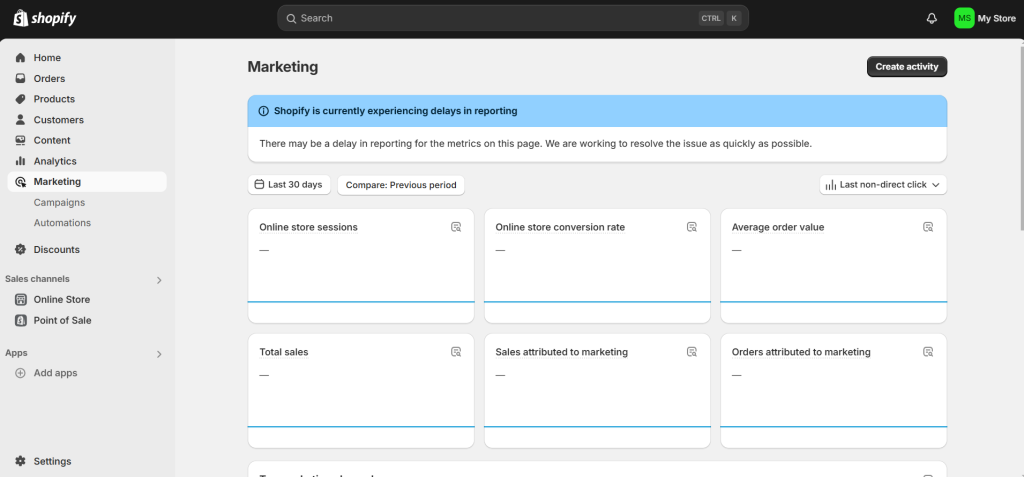
The core product handles all the essentials cleanly — product listings, inventory tracking, payment processing, shipping integrations, discount codes, abandoned cart recovery — without requiring any technical knowledge to configure. The app marketplace extends almost every function imaginable: subscriptions, loyalty programs, print-on-demand fulfillment, advanced analytics, product reviews, and more.
What Shopify does particularly well for small sellers is reduce the number of decisions you have to make. Pick a theme, add your products, connect your payment processor, set up shipping zones. The defaults are sensible. You’re not constantly second-guessing whether you’ve configured something correctly.
The friction point for genuinely small operations is cost. Shopify’s base plan starts at a monthly fee, and every app you add layers on additional subscriptions. If you’re selling a handful of products with modest monthly revenue, those costs add up proportionally faster. The platform earns its price as you scale — but in the very early stages, it’s worth being clear-eyed about what you’re paying before you’ve made your first sale.
For small sellers who expect to grow — and want a platform that grows with them without forcing a painful migration — Shopify is the clearest default recommendation.
BigCommerce — When You’re Smaller Than Enterprise but Need Enterprise Thinking
BigCommerce occupies a slightly different position in the market that gets underappreciated by small sellers who assume it’s only for large operations.

The fundamental advantage BigCommerce offers is that it doesn’t charge transaction fees on sales regardless of which payment processor you use. Shopify applies an additional fee if you use a third-party processor instead of Shopify Payments. For sellers in countries where Shopify Payments isn’t available, or those who have negotiated better rates with a specific payment provider, BigCommerce’s model can translate to meaningful savings at meaningful volume.
It also ships with a broader set of built-in features compared to Shopify — things like professional reporting, multi-currency support, faceted search, and customer group pricing come standard rather than requiring additional apps. For a small seller who wants to avoid subscription stacking across a dozen apps, having more built in from the start is genuinely valuable.
The tradeoff is a steeper learning curve. BigCommerce’s admin panel is comprehensive but less immediately intuitive than Shopify’s. Expect to spend more time in settings during initial setup. For a seller who is comfortable with that investment upfront in exchange for a cleaner recurring cost structure, the platform rewards that patience.
Gumroad — The Fastest Zero-to-Revenue Path for Digital Products
If you’re selling digital goods — courses, ebooks, templates, presets, software, music, art prints, memberships — Gumroad is worth understanding before you commit to a full e-commerce platform build.
Gumroad’s entire architecture is built around making it fast and frictionless to sell a digital product to a specific audience. No monthly subscription. No hosting setup. No theme selection. You create a product, set a price, get a link, share that link wherever your audience lives. That’s the complete workflow.
It handles payment processing, file delivery, receipt emails, and basic analytics automatically. The creator keeps the vast majority of revenue — Gumroad takes a flat percentage per transaction rather than a monthly fee. For someone testing whether an audience will actually pay for a digital product before investing in a full platform setup, that no-upfront-cost model is enormously valuable.
The honest limitations: Gumroad’s discovery features are limited compared to a marketplace, its customization is intentionally constrained, and building a proper brand experience around it is harder than with a dedicated storefront. But for a solo creator with an existing audience on a newsletter, YouTube, or social media who wants the shortest possible path from “I made a thing” to “someone bought the thing,” it’s unmatched for speed.
Etsy — Marketplace Access With a Built-In Audience
Etsy doesn’t fit the mold of a traditional e-commerce platform because it isn’t one — it’s a curated marketplace that happens to let sellers configure shop pages. But for small sellers in the right categories, ignoring it is a strategic mistake.
The appeal is straightforward: Etsy has hundreds of millions of active buyers who visit the platform specifically looking for handmade goods, vintage items, craft supplies, and personalized products. Showing up in Etsy search results is a legitimate customer acquisition channel that doesn’t require you to run ads or build an audience from scratch.
The practical constraints are equally straightforward. Etsy controls the algorithm, the search ranking factors, the fee structure, and the policies — all of which change periodically without your input. You are building a business on rented land. Your shop can be suspended, your search ranking can drop overnight, and your customer data doesn’t fully belong to you the same way it does on a self-hosted storefront.
The most effective approach for sellers whose products fit Etsy’s category is to treat it as a discovery and acquisition channel while simultaneously building a standalone store. Customers find you on Etsy; you invite them into your own ecosystem. That combination captures marketplace traffic without complete dependency on a platform you don’t control.
What You Should Actually Think About Before Choosing
Platform feature lists are almost irrelevant until you’ve answered these practical questions honestly.
How many products are you starting with? If the answer is fewer than twenty, almost any platform handles that volume comfortably. The differentiating factors — scalability, catalog management, variant handling — don’t bite until you’re significantly larger.
Are you selling physical goods, digital goods, or services? Physical goods need inventory management and shipping integrations. Digital goods need secure file delivery and often license key generation. Services need booking, scheduling, or project intake flows. Not all platforms handle all three equally well.
How comfortable are you with technical configuration? If you’re a developer or comfortable in settings panels, a higher-capability platform with a steeper learning curve is a reasonable investment. If you want to be selling within hours rather than days, prioritize platforms with minimal setup friction even at the cost of some flexibility.
What’s your realistic monthly budget for platform costs? Be honest here. Combining platform fees, payment processing, and essential apps on Shopify can run well above the base subscription price. Knowing your true all-in cost before you commit prevents a frustrating surprise sixty days later.
For context on getting payments flowing smoothly once your store is live, the guide on how to accept payments from customers online covers the payment processing layer in detail — including which processors work best with each platform type.
A Realistic Starting Recommendation
According to Statista’s global e-commerce platform market share data, Shopify holds the leading position among independent online stores — not because it’s perfect for every seller, but because it handles the broadest range of product types and growth stages without forcing a migration.
For a first-time seller with physical or mixed products and growth ambitions, Shopify is the lowest-risk choice. For a digital creator with an existing audience, Gumroad removes every possible barrier between you and your first sale. For sellers in handmade, vintage, or craft categories, Etsy is a traffic source that deserves a dedicated presence regardless of what else you build.
According to Shopify’s own commerce trend research, independent brands that invest in their own storefront alongside marketplace presence consistently outperform those who rely on any single channel. The platform you start on matters less than building the habit of owning your customer relationship from day one.
Conclusion
The best e-commerce platform for a small seller is the one that removes the most friction between you and your first sale, while keeping a clear path open for growth. That answer looks different depending on what you sell, who you’re selling to, and how much time you have to spend on setup. Pick the kitchen that matches where you’re cooking today — but check that it has room to expand when the orders start stacking up.



Leave a Comment