Proxy reliability is a topic that tends to surface urgently — after a scraping job fails halfway through, after a price monitoring pipeline returns hours of empty results, or after a client-facing automation tool starts returning errors at three in the morning. At that point, what matters most is not what a proxy provider claims on their pricing page but what their infrastructure actually delivers under real-world conditions.
Understanding proxy uptime statistics, failure patterns, and what separates genuinely reliable proxy infrastructure from infrastructure that merely appears reliable in ideal conditions is essential for anyone building systems that depend on consistent, uninterrupted proxy connectivity.
The Reliability Baseline: What Uptime Actually Means for Proxies
Uptime, in the context of proxy services, is more nuanced than the standard SLA figure most providers advertise. A provider claiming 99.9% uptime is making a statement about their control plane — the management infrastructure, the dashboard, the billing system. It says relatively little about the actual success rate of individual proxy connections, which is the number that matters operationally.
Proxy connection success rate and proxy network uptime are different metrics, and conflating them is a common source of confusion when evaluating proxy providers.
Network uptime measures whether the proxy infrastructure itself is reachable and functional. Most enterprise proxy networks operate at 99.5% to 99.99% network uptime, meaning the infrastructure is rarely completely offline. Outages of this type — full network blackouts — are uncommon with established providers.
Connection success rate measures what proportion of individual proxy requests actually return a valid, useful response from the target. This figure is significantly more variable and far more relevant to operational performance. Across proxy types, connection success rates range from around 85% for residential proxies on demanding targets to above 99% for datacenter proxies on permissive targets under controlled conditions.
The gap between these two figures is where proxy reliability actually lives.
Reliability Statistics by Proxy Type
Proxy type is the single largest determinant of reliability characteristics, and each type presents a distinct tradeoff profile.
Datacenter Proxies Datacenter proxies — IPs hosted in commercial data centers rather than assigned to residential internet subscribers — offer the most consistent raw performance. Connection latency is low and predictable, typically ranging from 20 to 100 milliseconds for geographically appropriate endpoints. Uptime at the infrastructure level regularly exceeds 99.9%.
The reliability vulnerability for datacenter proxies is detectability. Because their IP ranges are well-documented and associated with commercial hosting, sophisticated targets block or challenge datacenter IPs aggressively. On major e-commerce platforms, travel sites, and platforms with active anti-scraping measures, datacenter proxy success rates can fall to 40% to 60% — not because the proxy infrastructure failed, but because the target refused the connection. For use cases where the target is permissive or internal, datacenter proxies are highly reliable. For adversarial targets, their success rates tell a less flattering story.
Residential Proxies Residential proxies route traffic through IP addresses assigned to real home internet subscribers. Because these IPs appear to be genuine consumers, they are far less likely to be blocked by sites employing browser fingerprinting or IP reputation scoring.
Connection success rates for residential proxies on challenging targets typically range from 85% to 97%, depending on the provider’s network size, geographic coverage, and the quality of their rotation logic. The reliability tradeoff is latency variability — because residential IPs belong to real devices on real consumer networks, connection speeds and availability fluctuate based on when those devices are online. Timeouts are more common than with datacenter proxies, and connection latency ranges widely, often from 100 milliseconds to over 2 seconds for the same geographic endpoint across different sessions.
According to Proxyway’s annual proxy market research, residential proxy success rates vary by as much as 30 percentage points between providers on identical test targets, with the top-tier providers achieving consistent 94% to 98% success rates while lower-quality networks average closer to 70%.
ISP Proxies (Static Residential) ISP proxies sit between datacenter and residential proxies in the reliability landscape. They use IP addresses assigned by internet service providers to real subscribers, but hosted in data center infrastructure — which means they carry residential IP reputation without the latency and availability volatility of actual residential devices.
Success rates for ISP proxies on demanding targets typically range from 90% to 99%, with latency profiles closer to datacenter proxies (generally under 150 milliseconds). For use cases requiring both high throughput and strong IP reputation, ISP proxies often represent the most reliable option by connecting type-performance analysis.
Mobile Proxies Mobile proxies route traffic through mobile carrier IP ranges. Because mobile IPs are dynamic and shared across many legitimate users simultaneously, they carry very strong IP reputation and are rarely blocked even by the most aggressive anti-bot systems.
Success rates for mobile proxies on sophisticated targets regularly reach 95% to 99%. The reliability limitation is cost and throughput — mobile proxy bandwidth is significantly more expensive, and connection concurrency is limited compared to residential or datacenter pools. They are highly reliable for small-scale, high-stakes connections but operationally impractical for high-volume scraping workloads.
Factors That Degrade Proxy Reliability Below Benchmark
Several operational factors push real-world proxy performance below published or advertised benchmarks, and understanding them is prerequisite to diagnosing reliability issues in production systems.
- Pool size and rotation quality. A residential proxy network with a large pool of active IPs distributes request load across more endpoints, reducing the per-IP request frequency that triggers rate limiting and blocking. Small pools concentrate traffic on fewer IPs, accelerating their exhaustion and degradation. Providers with pools below a few hundred thousand active residential IPs frequently produce worse real-world success rates than their published statistics suggest.
- Geographic concentration. Most proxy pools are unevenly distributed geographically. A provider with 50 million residential IPs may have 40 million concentrated in the United States and a few Western European countries, with thin coverage elsewhere. Requests to targets that serve localized content or detect geographic inconsistency between a residential IP and a browser locale produce more failures in underrepresented regions.
- Session management. Many proxy failures are not infrastructure failures at all — they are session management errors. A scraping pipeline that reuses the same IP across too many requests without rotation, or that fails to properly handle cookies, headers, and fingerprinting signals consistently, will produce high failure rates regardless of the underlying proxy quality.
- Target aggressiveness. Major platforms—especially travel aggregators, retail marketplaces, and social networks—treat web scraping as an active arms race. When an engineering team rolls out a new Cloudflare, DataDome, or PerimeterX update on a Tuesday afternoon, proxy success rates that sat comfortably at 95% all morning can plummet within an hour. How frequently your target tunes its bot mitigation rules dictates your baseline stability far more than any provider’s generic SLA.
Tools Built Around Proxy Reliability
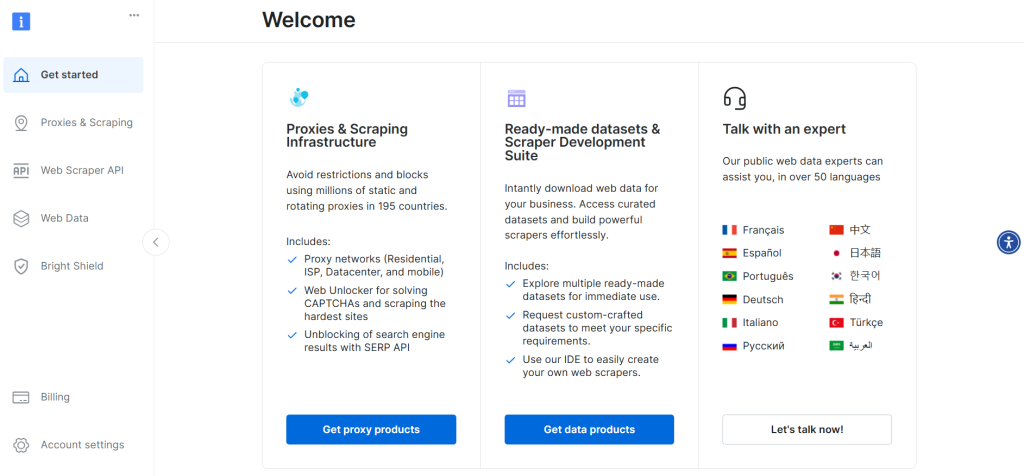

Bright Data is the largest residential proxy network by pool size, with over 72 million IPs across 195 countries. The platform publishes detailed success rate data segmented by target domain and proxy type, which gives users a basis for evaluating expected performance before deploying against specific targets. Bright Data’s infrastructure includes automated IP rotation, session control, and a scraping browser that manages fingerprinting at the browser level rather than the proxy level — which addresses many of the connection failures that arise not from proxy quality but from inadequate browser fingerprint consistency. For enterprise use cases where reliability benchmarks are contractual requirements, Bright Data’s transparency around performance data is a meaningful differentiator.
711Proxy tackles the stability problem by offering static residential IPs tied directly to consumer ISP contracts. Instead of bouncing between random peer devices that might go offline midway through a session, your scrapers hold onto clean, authentic IP addresses on dedicated data center hardware. That setup gives price scrapers and continuous monitoring tools the rock-solid connection speeds of a server farm without sacrificing consumer trust scores.
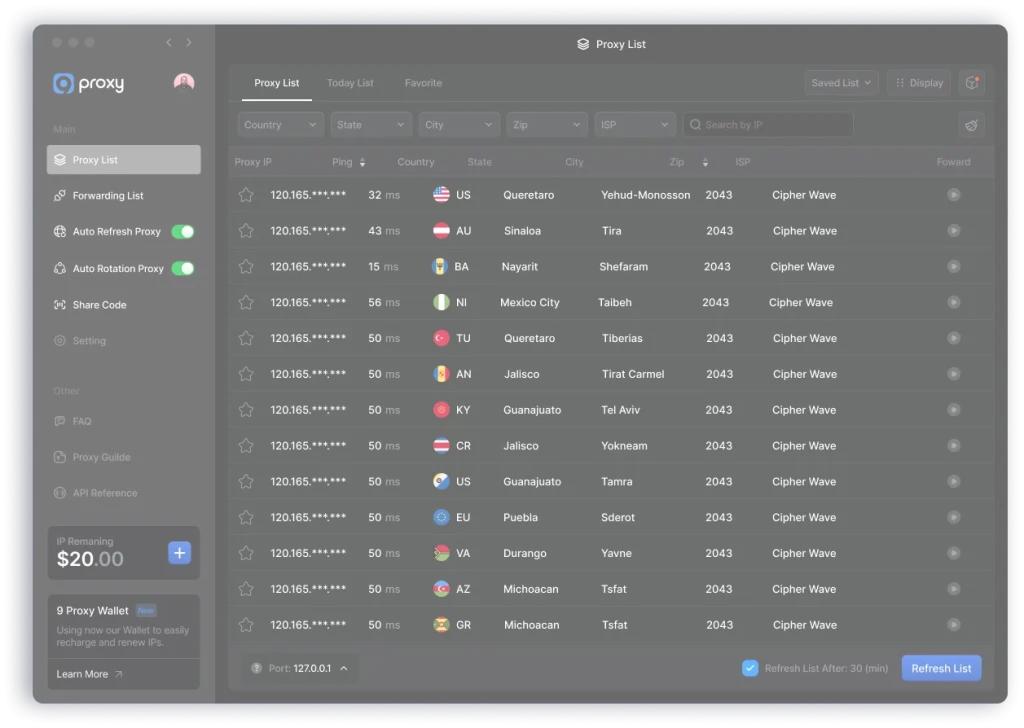
9Proxy specializes in clean residential pools and real 4G/5G mobile carrier routing. Because mobile carrier subnets share thousands of genuine smartphone users across rotating cellular towers, security firewalls rarely block them outright for fear of banning real customers. When you run into stubborn targets that reject standard residential traffic, routing through 9Proxy’s cellular nodes acts as a dependable bypass for mission-critical tasks.
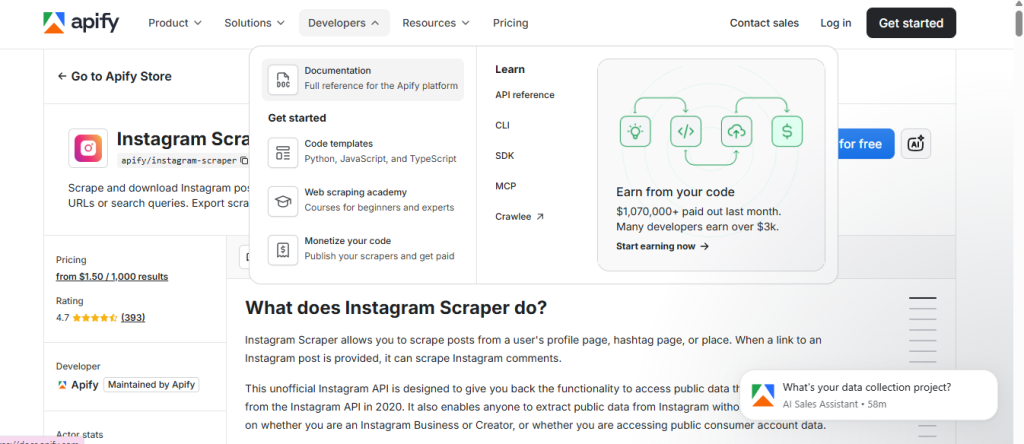
Apify approaches proxy reliability from the infrastructure automation layer rather than the raw proxy provision layer. The Apify platform integrates proxy management directly into its web scraping and automation workflows, handling proxy rotation, session management, and retry logic programmatically. When a proxy connection fails, Apify’s infrastructure automatically retries with a fresh endpoint without requiring manual intervention. For teams that lack dedicated infrastructure engineering capacity, this managed approach to proxy reliability often produces better effective success rates than manually managing raw proxy pools — because most reliability degradation in production systems comes from session and rotation logic failures, not from the proxy infrastructure itself. According to Oxylabs’ State of Proxy Usage Report, teams using managed scraping infrastructure with automated retry and rotation logic see 20% to 35% higher effective success rates than teams managing the same proxy pools manually.
How to Evaluate Proxy Reliability Before You Commit
The standard approach to proxy evaluation — reading provider comparison articles and benchmarks — produces results that are heavily dependent on when the benchmarks were run and which targets were used. Proxy performance is not static. A residential proxy pool that achieves 96% success rate on a particular e-commerce platform this month may achieve 78% next month after that platform updates its bot detection.
The more operationally honest approach is to run a direct pilot against your specific targets with a meaningful request volume — at minimum a few thousand requests across a 48-hour window to capture time-of-day variability in residential pool availability. Track success rate by proxy endpoint, not just overall, to identify whether failures are concentrated on specific IPs or distributed across the pool. A distributed failure pattern typically indicates target-side blocking improvements; a concentrated failure pattern typically indicates pool quality issues.
Latency percentiles are more diagnostic than latency averages. A proxy pool with a 300-millisecond average latency but a 95th percentile of 8 seconds is operationally quite different from one with a 400-millisecond average and a 95th percentile of 1.2 seconds. The tail latencies are where scraping pipelines stall.
Conclusion
Proxy reliability is not a single number — it is a profile that varies substantially by proxy type, target, geographic region, session management quality, and time. Published uptime figures from proxy providers describe infrastructure availability, not the connection success rate that matters to the systems running on top of that infrastructure.
The teams that build genuinely reliable proxy-dependent systems are the ones that measure what matters — actual success rates against their real targets — and invest in the session management and rotation logic that determines whether the underlying proxy infrastructure is used effectively or wasted.



Leave a Comment