Few technical decisions in e-commerce carry as much weight as the choice of payment gateway. It touches almost everything that matters: conversion rates at the final step of checkout, how reliably transactions clear, how chargebacks get handled, whether international buyers can pay in their preferred currency, and ultimately how much of every sale ends up in your account after fees. Store owners sometimes treat gateway selection as a backend plumbing decision—invisible infrastructure that customers never think about. In practice, the wrong choice quietly costs money, erodes checkout completion rates, and creates compliance headaches that surface at the worst possible times.
Understanding how payment gateway integration actually works, and which gateways handle which scenarios best, is worth more than any individual configuration detail. The configuration changes. The underlying logic doesn’t.
How Payment Gateways Actually Work
The moment a customer clicks “Pay Now,” a chain of events happens that most store owners never see but every transaction depends on. The gateway captures the payment details—card number, CVV, billing address—and encrypts them before transmitting to a payment processor, which routes the request to the customer’s card-issuing bank for authorization. An approval or decline comes back within a few seconds, the gateway relays it to your store, and the order either confirms or doesn’t.
What differentiates gateways is what happens around that core exchange. Some gateways handle the full payment processing pipeline including the processor relationship; others are purely the interface layer sitting between your store and a separate processor you contract with. Some host the payment form entirely on their own servers, which simplifies your PCI compliance obligations significantly. Others embed a form directly in your checkout page, which looks cleaner but means your servers briefly touch payment data and your compliance burden increases accordingly.
PCI DSS—the Payment Card Industry Data Security Standard—governs how cardholder data must be handled and stored. According to the PCI Security Standards Council, merchants who redirect customers to a hosted payment page maintained by their gateway operate at a lower compliance tier than those who handle card data directly. For most small to mid-sized stores, choosing a gateway that hosts the payment form is the practically correct decision even if it means slightly less control over the checkout aesthetic.
Choosing the Right Gateway for Your Store Type
There is no single best payment gateway. The right choice depends on where you sell, who your customers are, what your average transaction value looks like, and how technically your team is equipped to handle an integration.
- High-volume operations with engineers on hand usually prefer building directly on payment APIs. A custom checkout takes real dev work to deploy and maintain, but you own every pixel of the buying experience rather than fitting your brand into an off-the-shelf iframe.
- Solo founders and smaller shops get far more value out of pre-built integrations. You trade away deep layout control, but setup takes minutes instead of weeks, and the gateway handles compliance and updates without your team writing custom code.
- Subscription brands need more than basic charge processing. Look for gateways that handle tokenized card storage, automated retry schedules for declined cards, and automated email reminders to recover failed payments before subscribers quietly churn.
- International stores need to think carefully about currency support, local payment method coverage, and cross-border transaction fees. A gateway that works perfectly for US-based transactions may silently decline a significant percentage of European or Southeast Asian purchases simply because it doesn’t support the payment methods those buyers prefer.
Gateways Worth Integrating
Stripe
Stripe is the developer-first gateway that effectively reset expectations for what payment infrastructure should look like. The API is comprehensive without being obscure, the documentation is among the best in the industry, and the breadth of supported payment methods—cards, bank transfers, wallets, buy-now-pay-later options, local payment methods across dozens of countries—is difficult to match in a single integration.

For stores that need flexibility without building custom infrastructure, Stripe’s prebuilt checkout components handle the heavy compliance work automatically. For teams that want complete control, Stripe’s Elements library provides embeddable UI components that keep the card form in your page while Stripe’s servers handle the sensitive data. Standard transaction fees sit at 2.9 percent plus thirty cents per card transaction in the US, with interchange-plus pricing available for higher volumes. According to Stripe’s own documentation, their integration options span from simple redirect flows to fully custom payment orchestration—making it genuinely useful across a wide range of store sizes.
PayPal
PayPal brings a trust signal that no other gateway matches in certain demographics. A meaningful segment of online buyers—particularly in consumer retail—will complete a purchase specifically because they recognize the PayPal button and feel more comfortable paying through it than entering card details directly on a site they don’t know well. That conversion effect is real and worth accounting for when deciding whether to add PayPal alongside your primary gateway rather than instead of it.
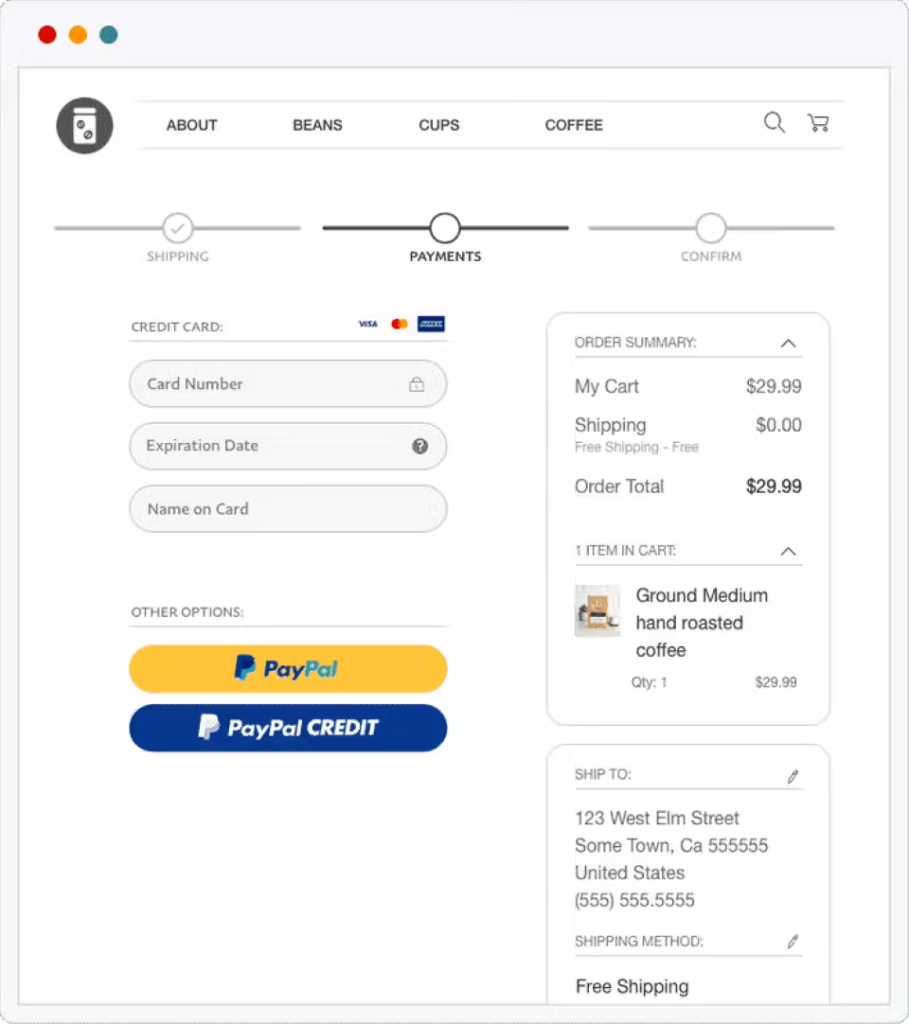
The integration complexity has decreased substantially with PayPal’s newer SDKs. Their Commerce Platform handles card payments, PayPal balance payments, and pay-later options through a single integration, which simplifies the technical footprint compared to older versions that required separate implementations for each payment type.
Authorize
Authorize.net has been processing payments long enough to have established deep integrations with virtually every major e-commerce platform, ERP system, and accounting tool in use today. For stores operating in environments where enterprise-grade compatibility and long-term vendor stability matter—healthcare-adjacent retail, B2B e-commerce, or stores where the back-office integration is as important as the customer-facing experience—Authorize.net’s broad ecosystem support is a practical advantage.
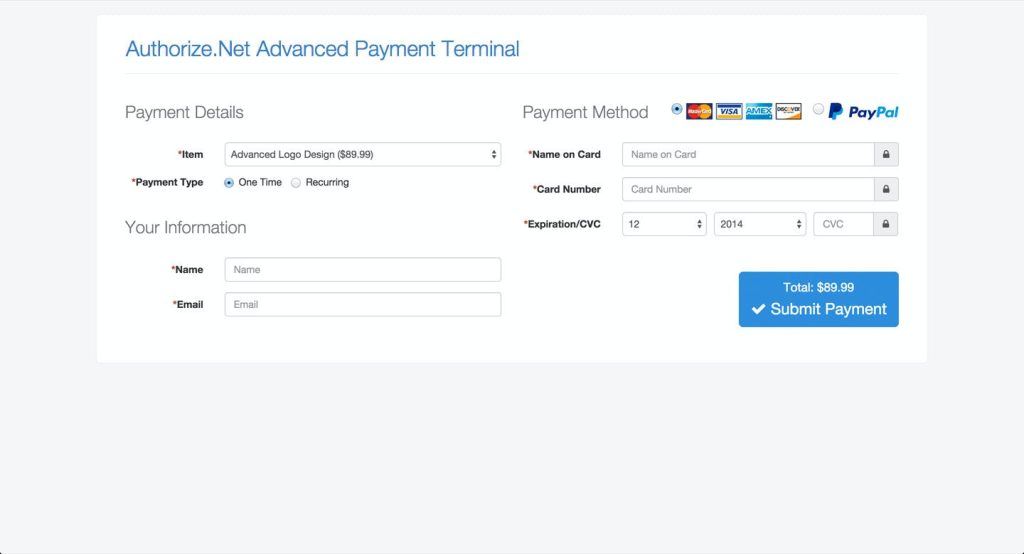
The fee structure combines a monthly gateway fee with per-transaction pricing, which makes it less economical for very low-volume stores but increasingly competitive as volume grows. The Advanced Fraud Detection Suite, included in most plans, applies rule-based screening to transactions before they’re submitted for authorization—useful for stores that have experienced elevated fraud rates.
Klarna operates in a different lane altogether. Instead of processing standard credit cards, Klarna offers buy-now-pay-later financing so customers can split purchases into installments or defer payment entirely. For higher-ticket items, offering split payments often makes the difference between a completed sale and an abandoned cart—spreading the cost across four equal payments lowers the barrier for hesitant buyers.
You rarely run Klarna by itself. Most merchants keep Stripe or another standard processor for regular credit cards and add Klarna at checkout as a secondary option for buyers who want installment financing. Klarna pays you upfront in full and handles collection on their end, taking the risk off your plate entirely.
Integration Checklist Before Going Live
A payment gateway integration isn’t finished just because your first test transaction clears. Run through a quick sanity check before taking live payments:
- Confirm webhooks are working and receiving events. Gateways send instant notifications—for charges, retries, refunds, and disputes—through webhooks. If your endpoint misses these, your order statuses will quickly fall out of sync.
- SSL is active and valid across the entire checkout path. Mixed content warnings or expired certificates at checkout will kill conversion and trigger browser security warnings.
- Failed payment flows are handled gracefully. Test a declined card and confirm the customer sees a useful error message rather than a generic failure page. The recovery experience matters.
- Map out refund and chargeback steps in advance. Your team should know who logs into the processor portal, where evidence gets submitted, and what paperwork is needed. Figuring this out during an active dispute leads to lost chargebacks.
Conclusion
Payment gateway integration sits at the intersection of customer experience, technical infrastructure, and financial operations. Getting it right means fewer abandoned carts at the payment step, lower compliance risk, and a cleaner path to resolving the inevitable transaction disputes that every store encounters.
Stripe is the practical default for most stores with any technical capability. PayPal adds genuine conversion value as a secondary option. Authorize is the right choice for stores with complex back-office integration requirements. And Klarna makes sense if you sell higher-ticket products where split payments help buyers pull the trigger.
The gateway choice is consequential, but it’s also recoverable. Most platforms support switching without a full rebuild. What matters more is understanding what your current gateway is and isn’t doing for your store—and making that evaluation with accurate data rather than defaults inherited from the initial setup.



Leave a Comment